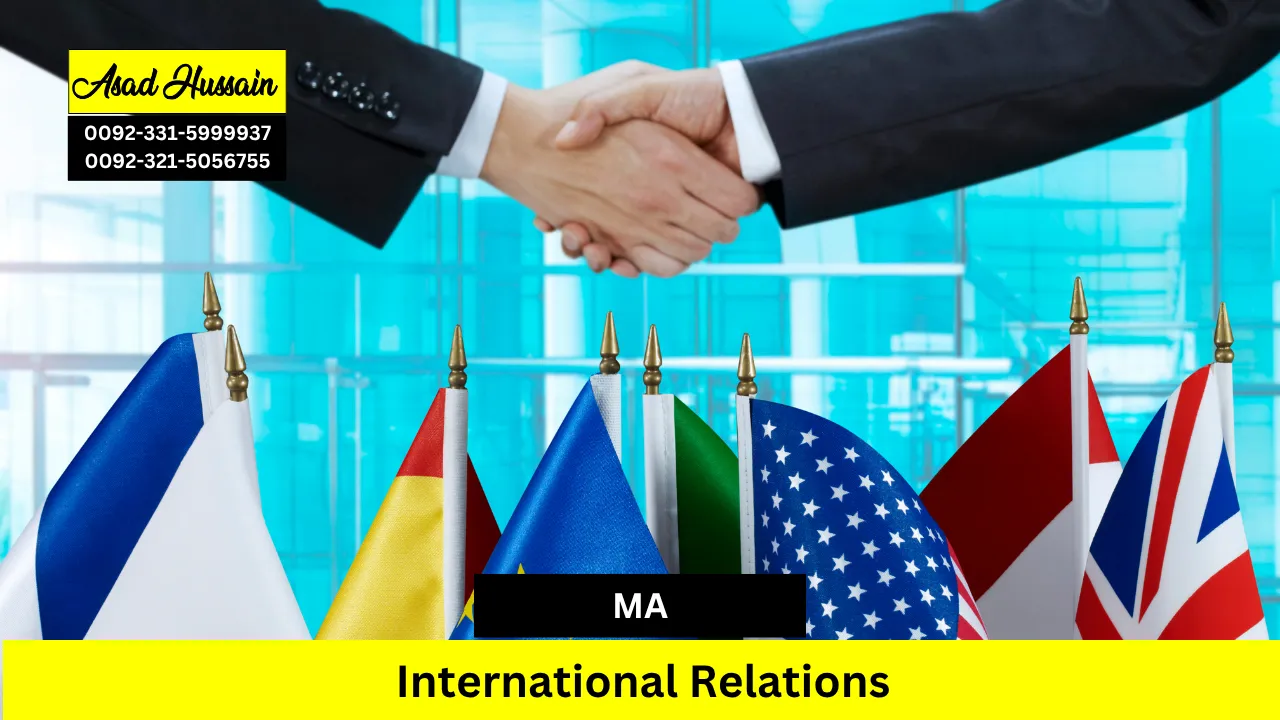
The MA International Relations is a postgraduate programme designed to develop advanced understanding of global politics, international systems, diplomacy, and contemporary world affairs. It is ideal for individuals who are interested in analysing political relationships between countries and understanding how global decisions shape societies, economies, and security.
This programme covers key areas such as international politics, foreign policy analysis, global governance, conflict resolution, international law, and diplomatic studies. Learners gain the ability to critically evaluate global issues, understand geopolitical dynamics, and develop informed perspectives on international relations in a rapidly changing world.
The qualification is suitable for graduates and professionals aiming to pursue careers in diplomacy, international organisations, government services, NGOs, journalism, or policy research. It prepares learners to engage with complex global challenges and develop the analytical and communication skills required for international careers and leadership roles in global affairs.
Inspire Institute of Technologies is an approved partner to deliver this program.
Program Highlights
Study Units
- The Practice of Diplomacy
- International Conflict Resolution
- Religion and International Relations
- International Relations: Theories and Challenges
- Security Studies
- Humanity in Peril: Navigating Security Concerns
- International Relations Dissertation and Research Methods
Entry Requirements
- Age Requirement: Applicants should generally be 21 years or older at the time of enrolment.
- Educational Requirement: A Bachelor’s degree or Level 6 qualification in International Relations, Political Science, History, Law, Sociology, Business, or a related field is required.
- English Language Proficiency: Strong English reading, writing, and communication skills are essential. Non-native speakers may need IELTS or equivalent qualification, or proof of previous education completed in English.
- Work Experience (Preferred): Relevant experience in government, NGOs, research, media, or international organisations is beneficial but not mandatory.
This programme is suitable for individuals aiming to build advanced knowledge in global affairs, diplomacy, and international political systems.
Learning Outcomes
The Practice of Diplomacy
On successful completion of the module, students will be able to:
- Demonstrate an understanding of the scope and central concerns of diplomatic studies as a subfield of International Relations, and its connections to related fields such as peace and conflict studies.
- Critically evaluate competing perspectives on contemporary diplomacy.
- Analyse the role of diplomacy in resolving international crises and conflicts and addressing global problems.
- Apply their knowledge of diplomatic practice and techniques of communication and negotiation.
International Conflict Resolution
On successful completion of this module, you will be able to demonstrate:
- A conceptual understanding that enables you to evaluate critically current research and advanced scholarship in the field of international conflict resolution
- An ability to evaluate particular attempts to transform conflicts, to derive possible lessons from them for other conflict situations and to grapple with the problems of designing strategies for resolving conflicts
- A critical understanding of the inter-disciplinary nature of international conflict resolution and its relationship with other fields of study and practice
- A systematic understanding of the roles of the different domestic, international and transnational actors involved in the creation of armed conflicts and of the ways in which such actors have interacted to transform such conflicts into peace processes
- An ability to apply insights from the field in their analysis of a particular case study and to demonstrate self-direction and originality in this work.
Religion and International Relations
At the end of this module students will:
- Understand how religion is or is not dealt with by international relations theory.
- Understand and analyse the main roles of religion in contemporary international relations.
- Gain an understanding of the debates about the role of religion in international relations and the rationale of the arguments put forward.
- Gain a detailed knowledge and understanding of the role of religion in relation to specific problems and policy issues.
- Develop critical abilities to analyse primary and secondary resources focused on religion and international relations, and be able to work independently, demonstrating initiative, self-organisation and time-management, as well as co-operating with other students to achieve common goals.
International Relations: Theories and Challenges
On successful completion of this module students will be able to:
- Appreciate the rich diversity in approaches to International Relations
- Contrast and compare different ‘paradigms’ in contemporary IR research.
- Critically evaluate the knowledge claims made by the various paradigms.
- Understand and critically assess debates among IR theorists on differing approaches to explanation and understanding in IR.
- Appreciate the ways in which the theoretical approaches relate to the practice of actors in international relations
Security Studies
On successful completion of this module you will be able to:
- Appreciate the rich diversity in current approaches to Security Studies
- Gain an understanding of the historical development of the discourses in Security.
- Assess the theoretical, historical, and scientific explanations for the causes of war.
- Evaluate the capabilities and limitations of military power as an instrument of policy.
- Understand the sources of conflict and co-operation in the international system.
- Gain an understanding of the place of Security Studies as a sub-discipline of International Relations
Humanity in Peril: Navigating Security Concerns
At the end of this module you will:
- Gain an understanding of debates about the meaning of security within international relations and the rationale for the development of a concept of ‘human security’
- Be able to demonstrate a detailed knowledge and understanding of the human security debate in relation to specific problems and policy issues ranging from the environmental change through food insecurity to migration and international crime
- Be able to demonstrate an understanding of the extent and limits of the impact of human security perspectives on the policies of the UN, EU and key states
- Develop critical abilities to analyse primary and secondary resources focused on human security.
- Enhance the capacity to work independently, demonstrating initiative, self-organisation and time-management, as well as co-operating with other students as partners to achieve common goals.
International Relations Dissertation and Research Methods
- Understand research methods and digital transformation frameworks
- Analyse and evaluate research for informed decision-making
- Design digital transformation strategies for organisations
- Apply project management skills in real-world business contexts
Work Based Project
On successful completion of this module students will be able to demonstrate the ability to:
- Understand and apply relevant social scientific research methods
- Formulate a significant research question and write a research proposal
- Conduct systematic research to answer their research question
- Evaluate critically relevant sources and evidence sources
- Reference their work thoroughly, using a consistent referencing system
- Produce a dissertation that is written, argued and structured rigorously, to expected postgraduate standards
Target Audience
The MA International Relations is designed for individuals who want to develop a deep understanding of global politics, diplomacy, and international affairs. It is ideal for those who are interested in how countries interact, how global policies are formed, and how international conflicts and cooperation are managed.
- Political Science And Social Science Graduates Seeking Advanced Knowledge In Global Affairs
- Aspiring Diplomats And Foreign Service Candidates Preparing For International Careers In Government And Embassies
- NGO And Humanitarian Workers Looking To Strengthen Policy And International Development Skills
- Journalists And Media Professionals Covering Global Politics, Conflicts, And International Issues
- Law And International Studies Graduates Interested In Global Governance And Legal Systems
- Policy Analysts And Researchers Working Or Planning To Work In Think Tanks And Research Organisations
- Career Switchers Entering International Affairs Field To Build Strong Analytical And Diplomatic Skills
This course is ideal for motivated individuals who want to engage with global challenges. It supports career growth in diplomacy, international organisations, policy-making, and global research roles.