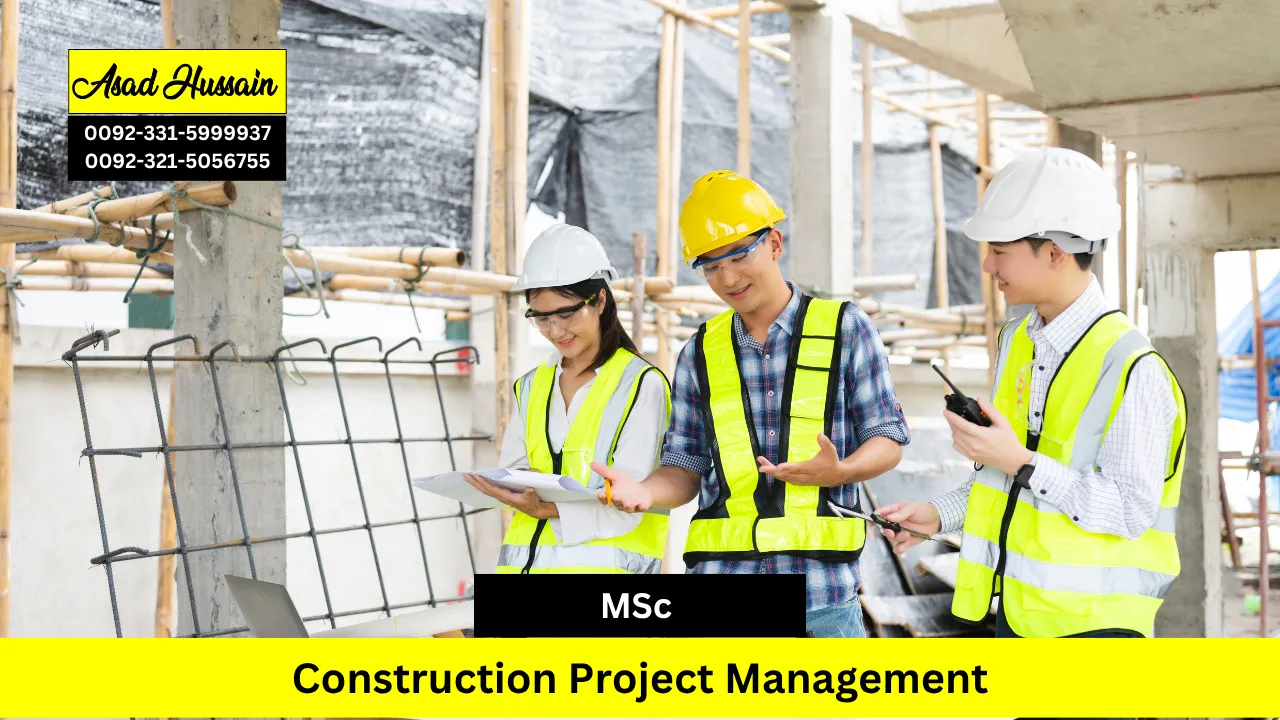
The MSc Construction Project Management is a postgraduate programme designed to develop advanced knowledge and professional skills in managing construction projects from initiation to completion. It is ideal for individuals who want to build strong expertise in planning, coordinating, and delivering complex construction projects efficiently, safely, and within budget.
This programme covers key areas such as construction project planning, contract administration, procurement management, cost control, risk management, and site management. Learners gain a deep understanding of how construction projects are managed in real-world environments, along with the ability to lead teams, manage resources, and ensure successful project delivery in the built environment sector.
The qualification is suitable for graduates and professionals aiming to progress into roles such as construction project manager, site manager, project coordinator, or construction consultant. It prepares learners to work in the global construction industry with strong technical, managerial, and leadership skills required to manage large-scale infrastructure and building projects effectively.
Inspire Institute of Technologies is an approved partner to deliver this program.
Program Highlights
Study Units
- Applied Research Project
- Procurement and Contract Practice
- Project Management Practice
- Project Management Principles
- Project Planning and Delivery
- Sustainable Built Environments
- Building a Successful Project Team
- Managing Risk and Uncertainty
Entry Requirements
- Age Requirement: Applicants should generally be 21 years or older at the time of enrolment.
- Educational Requirement: A Bachelor’s degree or Level 6 qualification in Construction Management, Civil Engineering, Quantity Surveying, Architecture, Building Technology, or a related built environment discipline is required.
- English Language Proficiency: Strong English communication skills are essential. Non-native speakers may need IELTS or equivalent qualification, or proof of prior education completed in English.
- Work Experience (Preferred): Relevant experience in construction, site supervision, project coordination, or engineering roles is beneficial but not mandatory.
This programme is suitable for individuals aiming to develop advanced construction project management skills and progress into senior roles in the construction industry.
Learning Outcomes
Applied Research Project
On completion of the module the learner, operating independently and applying their knowledge and skills, should be able to:
- Create a considered, topical, applied research project.
- Evaluate complex ideas and analysis in their area of study.
- Formulate a complex argument within a theoretical and practical framework.
- Demonstrate self-direction, confidence, resilience, ambition, and creativity in carrying out independent and evidence informed study in an area of the built environment.
- Communicate research findings through writing clear, comprehensible narrative in accordance with academic conventions.
Procurement and Contract Practice
On completion of the module, the learner, operating independently and applying their knowledge and skills, should be able to:
- distinguish between procurement methods with consideration of client requirements and the project governance when selecting an appropriate approach to procuring a construction project.
- demonstrate a systematic understanding of the key stages and processes in procuring services and works for various types of construction projects or programmes.
- propose project supply chain strategies, supported by cogent arguments considering a client organisation’s requirements, ESG goals, the project approach to risk, and other influencing factors.
- examine and appraise the legal context of Construction and Real Estate.
- appraise, select, and manage construction contracts, and the application of dispute resolution techniques, within a complex Built-Environment context.
Project Management Practice
On completion of the module the learner, operating independently and applying their knowledge and skills, should be able to:
- Evaluate the processes, activities, and roles in construction projects.
- Identify and differentiate between competing internal and external constraints and formulate a project delivery plan including responding to unfamiliar contexts.
- Identify and appraise the challenges of leading a complex construction project.
- Evaluate the effectiveness of project management methods in their practical application including the management of change.
- Propose practical contributions the construction project manager can make towards a sustainable low/zero carbon built environment.
Project Management Principles
On completion of the module, the learner, operating independently and applying their knowledge and skills, should be able to:
- investigate and critically evaluate the theories and concepts behind the Project Management discipline
- examine the nature of the Built Environment sector and the contribution professional bodies and professional ethics and values make towards sustainable construction
- appraise a project by measuring its aims and objectives against an organisation’s strategic objectives and available finance mechanisms
- design and deliver appropriate strategies to control and monitor key elements within the project lifecycle and a client setting that is complex and unpredictable
- autonomously display a deep and systematic understanding of how high performing management teams within a dynamic project environment are developed
- adopt an inclusive approach to practice and recognise the responsibilities, benefits and importance of supporting equity, diversity and inclusion
Project Planning and Delivery
On completion of the module, the learner, operating independently and applying their knowledge and skills, should be able to:
- synthesise information from a variety of sources to produce a work breakdown structure and project programme.
- interpret complex project requirements and information to develop a detailed project plan that evaluates and manages project risk and includes a programme identifying project milestones, resource requirements, critical path, and a site layout.
- propose feasible and achievable responses to project change events.
- propose critical responses to construction methodologies and measure the impacts to programme of alternative construction methodologies.
- use delay analysis techniques to assess and respond to changes to the project goals.
Sustainable Built Environments
On completion of the module, the learner, operating independently and applying their knowledge and skills, should be able to:
- articulate the key drivers behind the need to move towards a Sustainable Built Environment
- propose responses that can be made, at different scales, to move towards a sustainable Built Environment.
- evaluate the instruments through which Sustainable Built Environments are promoted and measured around the globe, including accreditation schemes and legislation.
- appraise the contributions the Built Environment professionals and Professional Bodies make towards Sustainable Built Environments.
- formulate responses based on evidence from research and practice.
Building a Successful Project Team
On completion of the module the learner, operating independently and applying their knowledge and skills, should be able to:
- Evidence a deep and meaningful knowledge and understanding of the role soft skills play in personal development and the role of the project manager.
- Identify and appraise the relationships of the stakeholders engaging in a project and their contributions towards the project’s success.
- Demonstrate thorough knowledge and understanding of cultural diversity, gender equality, and intercultural issues to support ethically aware, collaborative professional practice.
- Advance appropriate strategies to construct and maintain integrated project teams resilient to the internal and external constraints of a project.
- Evidence knowledge and understanding of the tools and techniques for managing organisational change
Managing Risk and Uncertainty
On completion of the module, the learner, operating independently and applying their knowledge and skills, should be able to:
- Utilise advanced techniques to identify and categorise risks considering their potential impact on project and organisational value.
- Evaluate and monitor the selected risk response strategies and consider their implications for value delivery and optimisation.
- Apply advanced quantitative risk analysis techniques while recognising their role in value driven decision making.
- Distinguish between risk and uncertainty and understand their implications for value management.
Target Audience
The MSc Construction Project Management is designed for individuals who want to develop advanced skills in planning, coordinating, and delivering construction projects efficiently.
- Construction Management Graduates Seeking Advanced Project Leadership And Technical Skills
- Civil Engineering Professionals Looking To Move Into Project Management Roles
- Quantity Surveyors And Site Engineers Aiming To Expand Into Project Coordination And Leadership
- Architects And Built Environment Graduates Interested In Construction Project Delivery
- Site Supervisors And Foremen Wanting To Progress Into Senior Management Positions
- Project Coordinators In Construction Industry Looking To Advance Their Career Path
- Career Switchers Entering Construction Sector To Build Strong Technical And Managerial Expertise
This course is ideal for motivated individuals who want to strengthen their leadership and organisational skills. It supports career growth in construction companies, consultancy firms, and infrastructure development organisations.