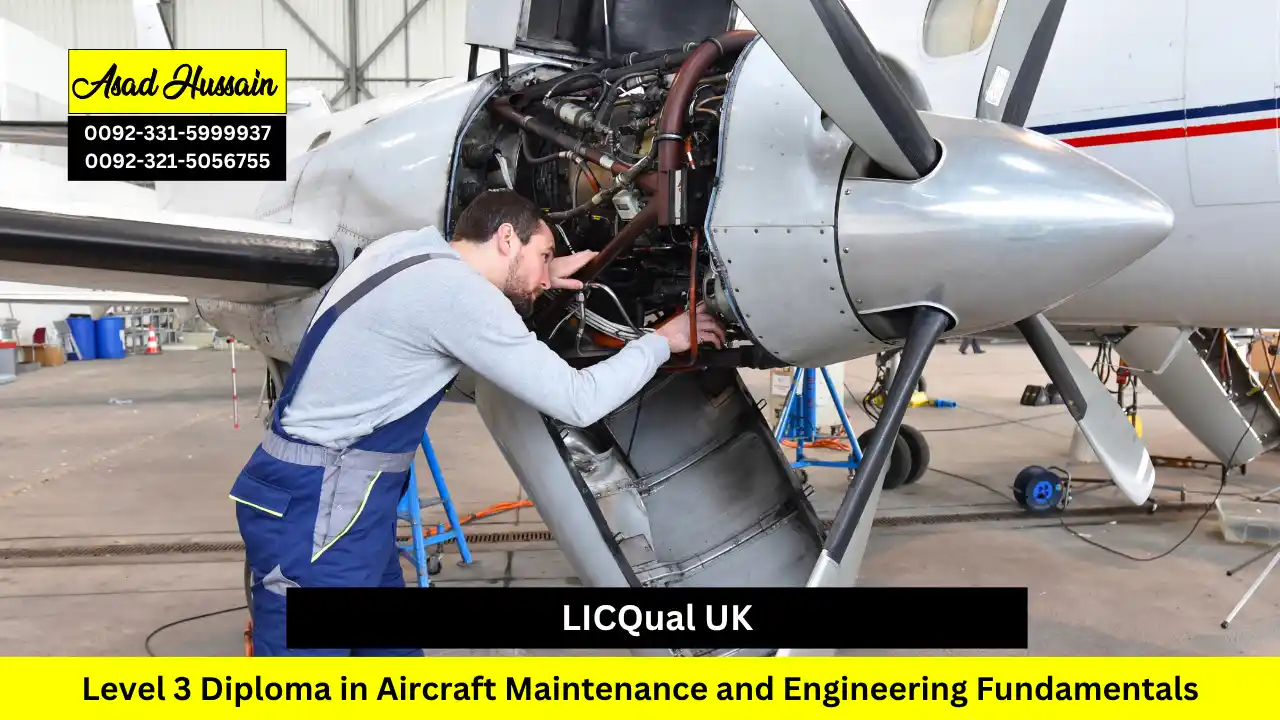
The LICQual UK Level 3 Diploma in Aircraft Maintenance and Engineering Fundamentals is a career-focused qualification designed to provide learners with the essential knowledge and practical understanding required to enter the aircraft maintenance and aviation engineering sector. The programme introduces the core principles of aircraft systems, engineering fundamentals, aviation safety, maintenance procedures, and airworthiness requirements, helping learners build a strong foundation for a successful career in aviation.
As aircraft technology continues to evolve, the aviation industry requires skilled professionals who understand the importance of safety, reliability, and technical excellence. This diploma equips learners with an understanding of aircraft structures, propulsion systems, avionics fundamentals, maintenance practices, and regulatory requirements that support safe and efficient aircraft operations. The qualification is designed to develop technical awareness, problem-solving abilities, and engineering knowledge relevant to modern aviation environments.
Ideal for aspiring aircraft technicians, aviation enthusiasts, school leavers, and individuals seeking a career in aviation engineering, this qualification provides a valuable pathway into the aerospace industry. Upon successful completion, learners will possess the fundamental skills and industry knowledge needed to pursue opportunities in aircraft maintenance, aviation engineering support, and further professional development within the global aviation sector
Program Highlights
Study Units
- Fundamentals of Aviation Science and Mathematics
- Aircraft Structures, Materials, and Basic Aerodynamics
- Aircraft Systems and Powerplant Fundamentals
- Aviation Safety, Human Factors, and Regulations
- Aircraft Maintenance Practices and Workshop Skills
- Technical Communication and Engineering Documentation
Entry Requirements
The following entry requirements are recommended to ensure learners can successfully complete the program:
- Age Requirement: Learners must be at least 18 years of age.
- Educational Background: Applicants should have successfully completed a secondary school qualification, high school certificate, GCSEs (or equivalent), or a recognised Level 2 qualification. A background in mathematics, physics, engineering, or technical subjects may be advantageous but is not mandatory.
- Professional Experience: No prior aircraft maintenance or aviation engineering experience is required. This qualification is designed for beginners and individuals wishing to start a career in the aviation and aerospace industry.
- English Proficiency: Learners should have a good understanding of English and strong communication skills.
Course Learning Outcome
By the end of this course, learners will be able to:
Fundamentals of Aviation Science and Mathematics
Learners will be able to:
- Apply core principles of mathematics and physics to solve aviation engineering problems.
- Demonstrate understanding of units, measurements, and conversions used in aircraft maintenance.
- Analyze forces, motion, and energy concepts relevant to flight and aircraft systems.
- Interpret scientific data and apply formulas to real-world aviation scenarios.
- Develop problem-solving skills for technical calculations in maintenance and engineering.
- Use aviation science knowledge as a foundation for advanced aircraft engineering studies.
Aircraft Structures, Materials, and Basic Aerodynamics
Learners will be able to:
- Identify key aircraft structural components and their functions.
- Explain the properties of aviation materials and their applications in aircraft design.
- Describe the principles of lift, drag, thrust, and weight in basic aerodynamics.
- Evaluate the impact of material selection on aircraft performance and safety.
- Apply knowledge of aerodynamics to understand flight stability and control.
- Recognize international standards for aircraft structures and material testing.
Aircraft Systems and Powerplant Fundamentals
Learners will be able to:
- Describe the operation of major aircraft systems including hydraulics, pneumatics, and fuel.
- Explain the fundamentals of piston and turbine powerplant systems.
- Identify common components of aircraft engines and their maintenance requirements.
- Analyze system diagrams to troubleshoot basic faults in aircraft systems.
- Apply safety procedures when working with aircraft systems and powerplants.
- Demonstrate knowledge of international aviation standards for system maintenance.
Aviation Safety, Human Factors, and Regulations
Learners will be able to:
- Explain the importance of aviation safety culture and risk management.
- Identify human factor issues such as fatigue, communication, and decision-making in maintenance.
- Apply international aviation regulations (EASA/ICAO/CAA) to maintenance practices.
- Evaluate case studies of aviation incidents to understand safety lessons.
- Demonstrate compliance with regulatory frameworks in maintenance environments.
- Promote safe working practices and teamwork in aviation engineering.
Aircraft Maintenance Practices and Workshop Skills
Learners will be able to:
- Perform basic maintenance tasks using industry-standard tools and equipment.
- Apply correct procedures for inspection, servicing, and repair of aircraft components.
- Demonstrate safe workshop practices including handling of hazardous materials.
- Interpret maintenance manuals and technical documentation accurately.
- Develop practical skills in troubleshooting and fault diagnosis.
- Apply international maintenance standards to ensure airworthiness compliance.
Technical Communication and Engineering Documentation
Learners will be able to:
- Interpret and produce technical drawings, diagrams, and engineering documents.
- Communicate effectively using aviation-specific terminology and reporting formats.
- Apply IT tools and digital platforms for maintenance record-keeping.
- Demonstrate accuracy and clarity in technical writing for aviation contexts.
- Evaluate the importance of documentation in regulatory compliance and safety.
- Collaborate with engineering teams using professional communication standards.
Target Audience
The LICQual UK Level 3 Diploma in Aircraft Maintenance and Engineering Fundamentals is designed for individuals who want to build a strong foundation in aircraft maintenance, aviation engineering, and aerospace technology. It is ideal for learners seeking to enter the aviation industry and develop the technical knowledge required for aircraft maintenance and engineering-related roles.
This course is ideal for:
- Individuals aspiring to start a career in aircraft maintenance and aviation engineering.
- School leavers seeking a recognised qualification in the aviation and aerospace sector.
- Aviation enthusiasts interested in understanding aircraft systems and engineering principles.
- Learners who wish to develop technical knowledge of aircraft maintenance procedures and safety requirements.
- Individuals seeking entry-level opportunities within airlines, airports, and Maintenance, Repair, and Overhaul (MRO) organisations.
- Engineering and technical learners looking to specialise in aviation-related disciplines.
- Professionals from mechanical, electrical, or technical backgrounds seeking a transition into the aviation industry.
- Aircraft maintenance assistants and junior technicians wishing to enhance their knowledge and career prospects.
- Learners preparing for higher-level qualifications in aircraft maintenance, aviation engineering, or aerospace technology.
- Individuals interested in gaining an understanding of aircraft structures, propulsion systems, avionics, and airworthiness requirements.
This qualification provides the essential skills and industry knowledge needed to begin a career in aircraft maintenance and engineering while supporting future progression into advanced aviation and aerospace studies.latory compliance are critical to operational success.tor.orldwide.ng within the global aviation industry.