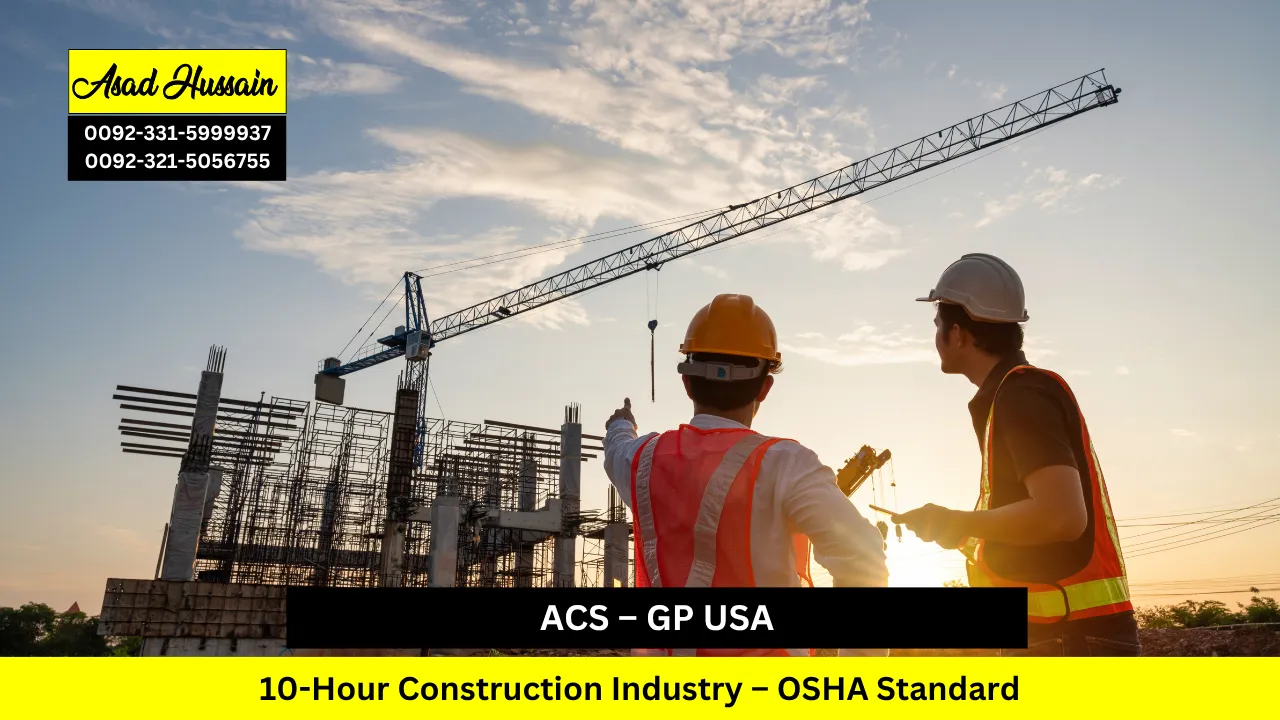
The ACS – GP USA 10-Hour Construction Industry – OSHA Standard course is designed to provide Learners with essential knowledge of workplace health and safety practices within the construction industry. This comprehensive awareness-level programme introduces key occupational safety concepts, helping workers recognise, avoid, and prevent common construction site hazards that can lead to injuries, illnesses, and accidents. The course covers critical topics such as fall protection, personal protective equipment (PPE), electrical safety, hazard communication, scaffold safety, excavation hazards, material handling, and workers’ rights and responsibilities.
Construction sites present numerous risks, making safety awareness a fundamental requirement for workers, supervisors, contractors, and organisations seeking to maintain safe and compliant working environments. Through practical guidance and industry-recognised safety principles, Learners develop a stronger understanding of hazard identification, risk reduction, accident prevention, and safe work practices.
The ACS – GP USA 10-Hour Construction Industry – OSHA Standard course supports the development of a proactive safety culture by promoting hazard awareness and responsible workplace behaviour. It is ideal for individuals entering the construction sector or professionals seeking to strengthen their understanding of construction safety requirements, workplace compliance, and accident prevention strategies while contributing to safer and more productive construction operations.
Program Highlights
Course Objective
- Understand OSHA’s role and 29 CFR 1926 standards for construction safety.
- Identify common construction hazards, including falls, electrical risks, and struck-by incidents.
- Learn safe work practices for tools, equipment, and personal protective equipment (PPE).
- Develop skills to recognize and report workplace safety violations.
- Explore OSHA’s Focus Four Hazards and mitigation strategies.
- Gain knowledge of workers’ rights and employer responsibilities under OSHA.
- Understand basic emergency response procedures for construction sites.
- Learn to document safety observations and incidents for compliance.
Entry Requirements
The following entry requirements are recommended to ensure learners can successfully complete the program:
- Age Requirement: Learners must be 18 years of age or older.
- Educational Background: No formal academic qualifications are required. A secondary school education or equivalent is recommended.
- Professional Experience: No prior construction or health and safety experience is required.
- English Proficiency: Learners should have a good understanding of English and strong communication skills.
Course Learning Outcomes
- Participants will understand key OSHA construction safety standards and compliance requirements.
- Learners will identify, assess, and control common construction site hazards effectively.
- Attendees will apply safe work practices and use personal protective equipment (PPE) correctly.
- Graduates will recognize and report safety violations and hazardous conditions confidently.
- Participants will apply knowledge of OSHA’s Focus Four Hazards in real workplace scenarios.
- Learners will understand workers’ rights and employer responsibilities under OSHA regulations.
- Attendees will accurately document safety incidents and support site compliance procedures.
Target Audience
The ACS – GP USA 10-Hour Construction Industry – OSHA Standard course is designed for individuals who work in or around construction environments and require a strong foundation in workplace health and safety awareness. It is suitable for both new and experienced professionals seeking to improve their understanding of construction site hazards and safe work practices.
This course is ideal for:
- Construction Workers and Labourers
- General Construction Operatives
- Site Supervisors and Team Leaders
- Construction Foremen
- Health and Safety Officers
- Safety Coordinators
- Site Engineers
- Civil Engineers
- Electrical Workers and Electricians
- Plumbers and Pipefitters
- Carpenters and Joiners
- Roofers and Scaffold Workers
- Maintenance and Repair Personnel
- Heavy Equipment and Machinery Operators
- Contractors and Subcontractors
- Building and Infrastructure Workers
- Utility and Telecommunications Workers
- Warehouse and Material Handling Personnel
- Project Managers and Construction Managers
- Individuals Entering the Construction Industry
The course is particularly beneficial for workers who are exposed to common construction hazards such as falls, electrical risks, struck-by incidents, caught-in or between hazards, unsafe equipment use, and material handling activities. It helps Learners develop the knowledge needed to recognise workplace hazards, follow safe work procedures, support regulatory compliance, and contribute to a safer construction environment.
By completing this course, Learners can strengthen their safety awareness, reduce workplace risks, improve accident prevention practices, and promote a positive safety culture across construction projects and worksites.