
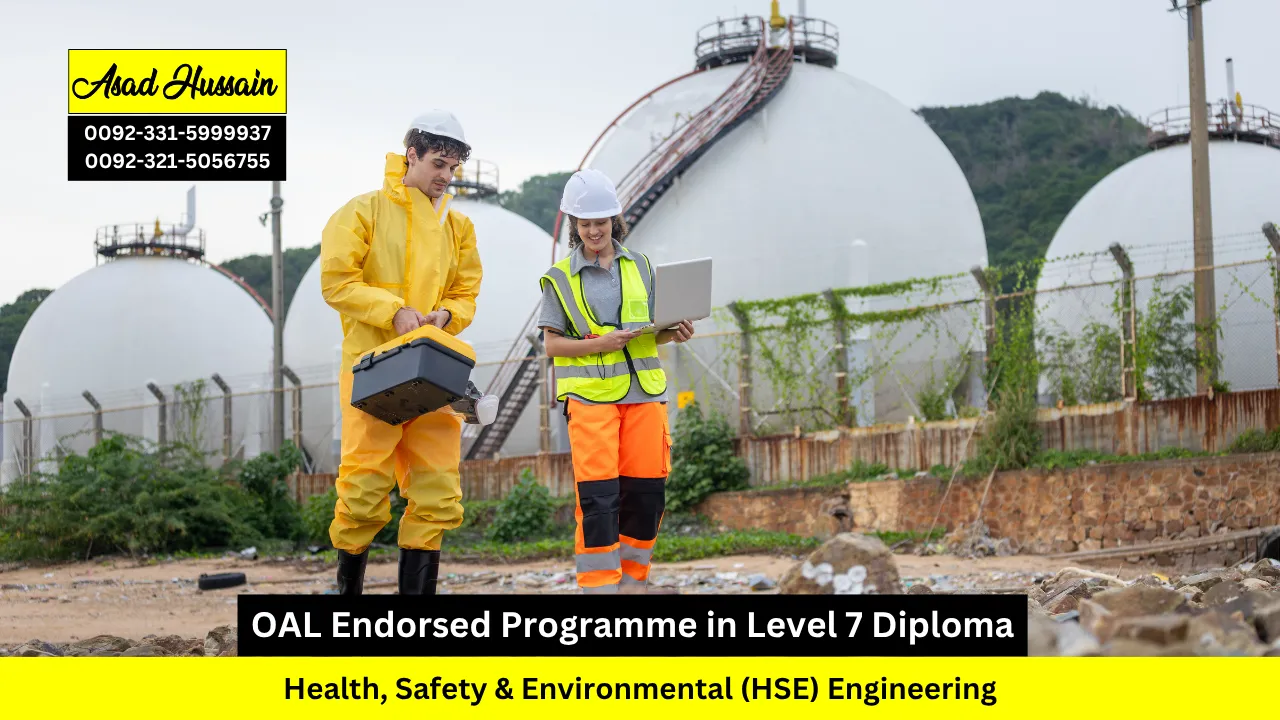
The OAL Endorsed Programme in Level 7 Diploma in Health, Safety & Environmental (HSE) Engineering is an advanced professional programme designed for Learners seeking to develop strategic knowledge and expertise in health, safety and environmental engineering. It focuses on the principles, systems and practices required to identify workplace hazards, manage occupational risks, improve environmental performance and support effective HSE management across complex organisational environments.
This Level 7 HSE Engineering programme enables Learners to explore advanced approaches to risk assessment, health and safety management, environmental protection, incident prevention, emergency preparedness, regulatory compliance and safety culture. It is particularly relevant to professionals working in construction, engineering, manufacturing, energy, oil and gas, facilities management and other safety-critical industries.
The programme is suitable for health and safety professionals, HSE engineers, safety managers, environmental professionals, risk specialists, engineering managers and experienced practitioners seeking to strengthen their strategic HSE knowledge. Learners can develop the ability to evaluate organisational HSE challenges, recommend effective control strategies and contribute to continuous improvement and sustainable workplace practices.
By completing the OAL Endorsed Level 7 Diploma in HSE Engineering, Learners can enhance their professional profile, expand their understanding of integrated health, safety and environmental management, and prepare for higher-level responsibilities in HSE, risk management, environmental compliance and engineering safety.
Program Highlights
Study Units
- Advanced Principles of Health, Safety & Environmental Engineering
- Risk Assessment, Hazard Control & Integrated Safety Management Systems
- Environmental Sustainability, Compliance & Performance Monitoring
- Incident Investigation, Root Cause Analysis & Corrective Action Planning
- Strategic Leadership, Organisational Culture & Behavioural Safety
- Innovation, Technology & Continuous Improvement in HSE Engineering
Entry Requirements
The OAL Endorsed Programme in Level 7 Diploma in Health, Safety & Environmental (HSE) Engineering is designed for experienced Learners seeking advanced knowledge in HSE engineering, risk management and environmental safety.
- Age: Normally 21 years or above.
- Education: Relevant Level 6 qualification, diploma or equivalent qualification is recommended.
- Experience: Relevant HSE, health and safety, environmental or engineering experience is beneficial.
- English Language: Sufficient English reading, writing and communication skills.
- Professional Background: Suitable for HSE professionals, safety managers, engineers, environmental professionals and risk specialists.
- Prior Learning: Relevant qualifications and professional experience may be considered by the approved centre.
Course Learning Outcome
Learning Outcomes for the Endorsed Programme in Level 7 Diploma in Health, Safety & Environmental (HSE) Engineering (Inspire College of Technologies):
Advanced Principles of Health, Safety & Environmental Engineering
- Demonstrate a critical understanding of advanced HSE engineering principles and their application in diverse industries.
- Evaluate global standards, frameworks, and regulatory requirements shaping occupational health and environmental safety.
- Apply engineering methodologies to design systems that minimize hazards and optimize workplace safety.
- Integrate multidisciplinary approaches to address complex safety and environmental challenges.
- Assess the impact of technological and scientific advancements on modern HSE practices.
- Develop strategies that align safety engineering with sustainable development goals.
Risk Assessment, Hazard Control & Integrated Safety Management Systems
- Conduct comprehensive risk assessments using qualitative and quantitative methodologies.
- Identify, evaluate, and prioritize hazards across industrial and organizational contexts.
- Design and implement hazard control measures that meet international safety standards.
- Apply integrated safety management systems to ensure compliance and operational efficiency.
- Critically analyze the effectiveness of risk mitigation strategies in real‑world scenarios.
- Promote a proactive safety culture through systematic monitoring and evaluation.
Environmental Sustainability, Compliance & Performance Monitoring
- Examine environmental sustainability frameworks and their relevance to engineering practices.
- Apply compliance strategies to meet national and international environmental regulations.
- Evaluate performance monitoring tools for measuring environmental impact and efficiency.
- Design initiatives that reduce ecological footprints while maintaining operational productivity.
- Integrate sustainability principles into organizational policies and engineering solutions.
- Critically assess the role of environmental audits in continuous improvement.
Incident Investigation, Root Cause Analysis & Corrective Action Planning
- Apply systematic approaches to incident investigation and reporting.
- Conduct root cause analysis to identify underlying factors contributing to safety failures.
- Develop corrective and preventive action plans that address systemic weaknesses.
- Evaluate the effectiveness of incident management frameworks in organizational contexts.
- Strengthen accountability and transparency through structured documentation and follow‑up.
- Promote organizational learning by transforming incidents into opportunities for improvement.
Strategic Leadership, Organisational Culture & Behavioural Safety
- Demonstrate leadership strategies that foster a positive safety culture.
- Evaluate the role of organizational behaviour in influencing safety outcomes.
- Apply behavioural safety models to reduce risks and improve compliance.
- Develop policies that integrate leadership, culture, and safety performance.
- Critically analyze case studies of leadership impact on HSE practices.
- Promote employee engagement and accountability through strategic communication.
Innovation, Technology & Continuous Improvement in HSE Engineering
- Assess the role of emerging technologies in advancing HSE engineering practices.
- Apply innovative tools and digital solutions to enhance safety and environmental performance.
- Design continuous improvement frameworks that integrate innovation with compliance.
- Evaluate the impact of automation, AI, and data analytics on risk management.
- Promote a culture of innovation that drives sustainable safety outcomes.
- Critically reflect on global trends shaping the future of HSE engineering.
Target Audience
The OAL Endorsed Programme in Level 7 Diploma in Health, Safety & Environmental (HSE) Engineering is designed for experienced Learners and professionals seeking advanced knowledge of integrated health, safety and environmental management within engineering and safety-critical workplaces.
- HSE Professionals seeking advanced knowledge and career progression in health, safety and environmental management.
- HSE Engineers responsible for managing workplace hazards, risk controls and environmental considerations.
- Health and Safety Managers involved in developing and implementing organisational HSE strategies.
- Environmental Professionals seeking to strengthen their understanding of environmental risk and compliance.
- Safety Officers and Advisors looking to progress towards senior HSE responsibilities.
- Risk Management Professionals involved in identifying, assessing and controlling organisational risks.
- Engineering Managers and Supervisors responsible for maintaining safe and compliant engineering operations.
- Construction Professionals managing occupational health, safety and environmental risks on complex projects.
- Oil and Gas Professionals working within safety-critical and environmentally sensitive operations.
- Manufacturing and Industrial Professionals responsible for workplace safety and environmental performance.
- Learners with Relevant Level 6 Qualifications seeking advanced Level 7 study in HSE engineering.
- Experienced Practitioners seeking to strengthen their professional profile and prepare for strategic HSE responsibilities.
Expand Your Professional Opportunities
OAL Endorsed Programme in Level 7 Diploma in Health, Safety & Environmental (HSE) Engineering can support professional progression and may provide access to further recognition and verification pathways, subject to the requirements of the relevant organisations.
BCSP – TSP® Pathway
The qualification provides a potential pathway towards the Transitional Safety Practitioner® (TSP®) designation through the Qualified Equivalent Program (QEP) of the Board of Certified Safety Professionals (BCSP).
British Council
The qualification may also be suitable for document attestation, verification and related recognition processes through the British Council, subject to the applicable requirements and verification procedures.
Ministry of Foreign Affairs (MOFA)
The qualification may be suitable for document attestation, verification and related recognition processes through the Ministry of Foreign Affairs (MOFA), depending on the purpose and applicable requirements.
Professional & International Recognition
These pathways can support learners seeking professional progression, qualification verification or international documentation. Requirements may vary according to the organisation, country and intended purpose.