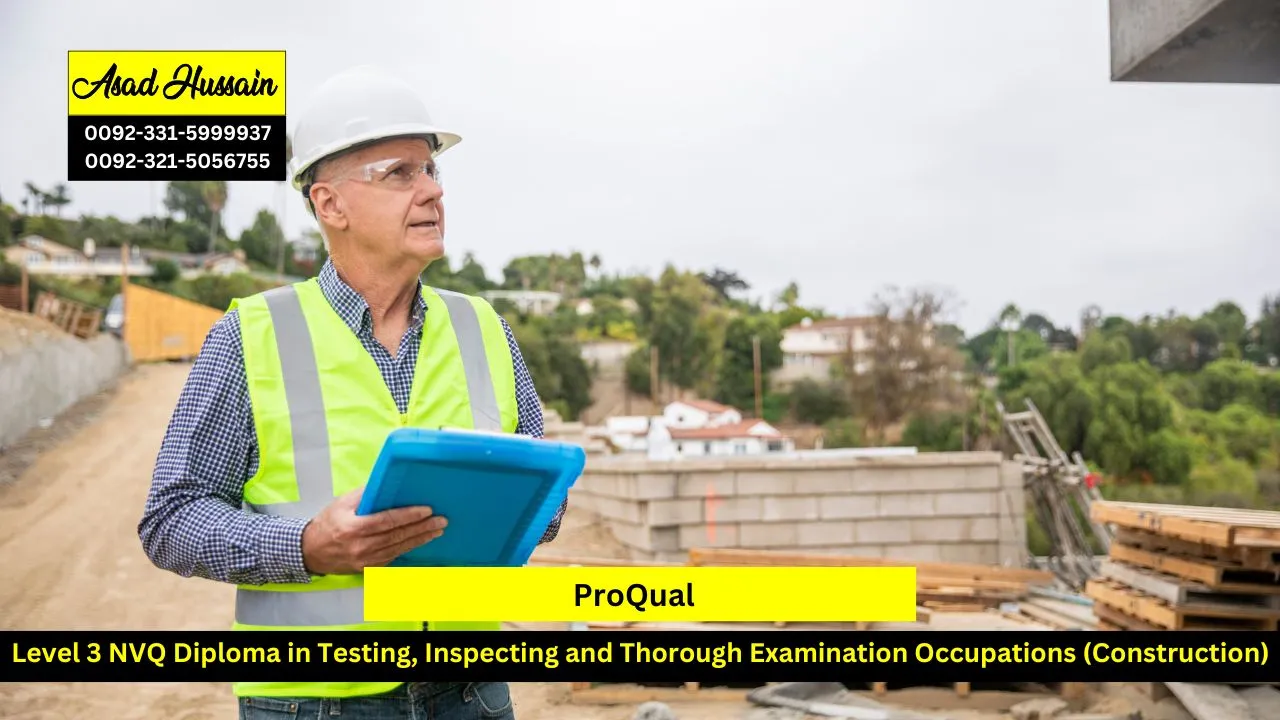
The ProQual Level 3 NVQ Diploma in Testing, Inspecting and Thorough Examination Occupations (Construction) is therefore the definitive credential for specialists in this safety-critical field. Achieving this diploma provides demonstrable proof to employers, clients, and enforcement bodies of your certified competency and authority to carry out these vital examinations, underpinning the highest standards of health and safety management within the construction industry.
This industry-recognised diploma provides the formal competency framework for professionals responsible for the statutory testing, inspection, and thorough examination of work equipment and structures on construction sites. The programme focuses on developing the advanced practical skills and in-depth technical knowledge required to ensure all equipment—from lifting gear and plant machinery to access equipment and temporary works—is safe for use and compliant with regulations. It is delivered through on-site assessment, validating your ability to apply stringent safety standards in real-world environments.
Candidates will master the systematic processes for conducting thorough examinations, accurately interpreting and applying relevant legislation such as LOLER and PUWER, and producing clear, legally defensible reports and certification. The curriculum is designed to instil a rigorous, methodical approach to identifying defects, understanding failure modes, and making critical pass/fail decisions that directly impact site safety. This qualification elevates practitioners from performing tasks to taking full professional responsibility for the integrity and safety compliance of critical construction equipment.
Program Highlights
The ProQual Level 3 NVQ Diploma in Testing, Inspecting and Thorough Examination Occupations (Construction), To achieve the qualification candidates must complete ALL of the Mandatory units, plus the Mandatory unit(s) for ONE of the Pathways.
Mandatory Units
Mandatory Units – Complete All Units
| Title | Level |
| Confirming work activities and resources for an occupational area in the workplace | 3 |
| Developing and maintaining good occupational working relationships in the workplace | 5 |
| Confirming the occupational method of work in the workplace | 3 |
Pathway 1 – Testing, Inspecting and thorough Examination of Plant, Machinery, Equipment or Accessories
| Title | Level |
| Inspecting plant or machinery for operational serviceability in the workplace | 2 |
| Carrying out specific tests on plant or machinery to determine operational serviceability in the workplace | 3 |
Pathway 2 – Leak Detection in Waterproof Systems
| Title | Level |
| Detecting breaches in waterproofing systems using non- destructive leak detection in the workplace | 3 |
Pathway 3 – Dynamic Pile Testing ( Mandatory Unit – complete this unit)
| Title | Level |
| Dynamic load and integrity testing of piles in the workplace | 3 |
Entry Requirements
This is a competency-based qualification that validates professional skills in a safety-critical role. To ensure candidates can successfully engage with the assessment process, the following core requirements must be met:
- Occupational Role & Experience: Applicants must be employed in a relevant construction role where testing, inspection, and thorough examination is a primary duty. Access to suitable workplace evidence is essential for assessment.
- Educational & Industry Background: A strong foundational knowledge is required, typically evidenced by holding related certifications such as a Level 2 or 3 NVQ in a relevant construction trade, a CPCS or NPORS Competence Card for plant-related roles, or specific product manufacturer training.
- Language Proficiency & Capacity: Candidates must possess proficient English language skills to understand complex technical documentation, interpret legislation, and produce detailed, accurate examination reports and certification.
- Supporting Your Application: A background demonstrated by prior qualifications in plant operations, electrical installation, scaffolding, or non-destructive testing (NDT) is highly advantageous.
Each application is reviewed individually, with strong emphasis on current occupational suitability and the ability to generate the required on-site evidence to prove competency.
Learning Outcomes
Upon successful completion of the ProQual Level 3 NVQ Diploma in Testing, Inspecting and Thorough Examination Occupations (Construction), participants will achieve the following learning outcomes:
1. Conduct Comprehensive Inspections
Demonstrate the ability to perform thorough inspections of construction materials, equipment, and systems, ensuring compliance with relevant standards and regulations.
2. Apply Testing Techniques
Effectively apply various testing methods to evaluate the quality and performance of construction components, accurately identifying any defects or non-conformities.
3. Understand Compliance Regulations
Exhibit a strong understanding of applicable health and safety legislation, ensuring that all testing and inspection activities adhere to legal requirements and industry standards.
4. Identify and Document Issues
Recognize and report any deficiencies found during inspections and testing, providing clear and detailed documentation of findings for stakeholders.
5. Communicate Findings Clearly
Demonstrate effective communication skills, both written and verbal, to convey inspection results and recommendations to team members, clients, and management.
6. Conduct Risk Assessments
Perform risk assessments related to testing and inspection activities, identifying potential hazards and implementing control measures to mitigate risks.
7. Produce Accurate Reports
Create comprehensive reports that summarize inspection findings, testing results, and recommended corrective actions, ensuring clarity and accuracy in documentation.
8. Promote Quality Assurance
Contribute to quality assurance processes by engaging in continuous improvement initiatives and promoting best practices in testing and inspection activities.
Target Audience
This Level 3 NVQ is designed for experienced construction practitioners who hold, or are progressing into, formal responsibility for the statutory safety and compliance of equipment and structures. It is an essential qualification for:
- Testers and Inspectors: Professionals formally appointed to carry out thorough examinations of lifting equipment (under LOLER), pressure systems, or access equipment, ensuring they are safe for operational use.
- Competent Persons & Specialists: Individuals designated as a “Competent Person” for testing and inspection within their organization, or specialists in areas like non-destructive testing (NDT), scaffolding inspection, or plant machinery examination.
- Advanced Tradespeople & Site Supervisors: Skilled tradespeople (e.g., in electrical, plant, or steelwork), foremen, and supervisors who need certified, formal recognition of their inspection skills to meet regulatory and contractual obligations.
Ultimately, this diploma is for the crucial professionals who act as the final safety checkpoint, providing the certified proof of competency required to sign off equipment as safe and legally compliant on construction sites.