Advance Your Clinical Nursing Precision: Professional Diploma
OSHAA 30-Hours Diploma in Nursing Care for Patients provides a specialized clinical framework for healthcare assistants and nursing practitioners. By focusing on patient assessment and clinical safety, this course empowers you to lead care initiatives and manage recovery plans with absolute precision. It is a focused, non-Ofqual regulated program tailored for those seeking to sharpen diagnostic insights and command respect within the modern hospital sector. You will explore advanced methods for monitoring vital signs and implementing care protocols, ensuring you possess a technical toolkit to solve real-world nursing challenges while maintaining high standards of patient dignity and clinical efficiency.
Stepping into this technical training means committing to a journey of professional development and specialized skill acquisition. The syllabus focuses on the strategic management of clinical resources, bridging the gap between basic assistance and high-level professional nursing standards. Throughout the comprehensive modules, you will refine your ability to analyze patient needs and evaluate the efficacy of nursing interventions. This is a premier opportunity to distinguish yourself as a knowledgeable practitioner, gaining the specialized insights necessary to protect patients from healthcare-associated risks and uphold the highest standards of clinical governance within your specific medical jurisdiction or private practice while focusing on the practical mastery of patient care systems.
OSHAA 30-Hours Diploma in Nursing Care for Patients serves as a powerful catalyst for those aiming to achieve significant professional standing. Upon completion, you will be well-positioned to pursue prestigious industry certifications and specialized diplomas that further validate your expertise in advanced clinical nursing and patient management. By focusing on vocational mastery, this program ensures your credentials remain relevant and highly sought after by top-tier employers in the medical and acute care sectors. You are securing a competitive edge that opens doors to supervisory roles, providing the specialized authority required to lead nursing teams and manage sophisticated care portfolios with unmatched technical precision.
Program Highlights
Study Units
- Introduction to Nursing Care and Patient-Centred Practice (3 Hours)
- Monitoring Vital Signs and Clinical Observations (4 Hours)
- Personal Hygiene, Mobility, and Basic Care Procedures (3 Hours)
- Nutrition, Hydration, and Supporting Daily Living Activities (5 Hours)
- Infection Prevention and Control in Clinical Settings (4 Hours)
- Effective Communication and Compassionate Patient Interaction (3 Hours)
- Understanding Legal, Ethical, and Professional Responsibilities (5 Hours)
- Supporting Mental Health and Emotional Wellbeing in Patients (3 Hours)
Entry Requirements
To enroll in the OSHAA 30-Hours Diploma in Nursing Care for Patients, candidates must demonstrate the academic foundation and professional maturity required for high-stakes clinical environments.
- Age & Education: Applicants must be 18+ years old and possess a foundational healthcare background, such as a Diploma in Health and Social Care or a Certificate in First Aid and Basic Life Support.
- Language & Experience: A professional command of English is essential for interpreting clinical charts, along with at least one year of work experience in a hospital, residential care home, or community health setting.
- Professional Standing: Individuals holding vocational certificates in anatomy or diplomas in clinical support worker training are ideally positioned to succeed in this technical program.
Meeting these entry standards ensures you have the necessary clinical awareness to master patient monitoring protocols and uphold the highest levels of nursing excellence and ethical accountability.e.
Learning Outcomes
The OSHAA 30-Hours Diploma in Nursing Care for Patients is organized into eight technical modules, providing a specialized clinical framework for mastering bedside care, clinical monitoring, and patient-centered protocols.
Introduction to Nursing Care and Patient-Centred Practice
- Master the core principles and values that define professional nursing care.
- Recognize the strategic importance of person-centered approaches in long-term patient support.
- Identify the distinct roles and hierarchical responsibilities within a clinical nursing team.
- Promote a culture of dignity, respect, and empathy across all patient interactions.
- Analyze the impact of holistic care on psychological and physiological recovery.
Monitoring Vital Signs and Clinical Observations
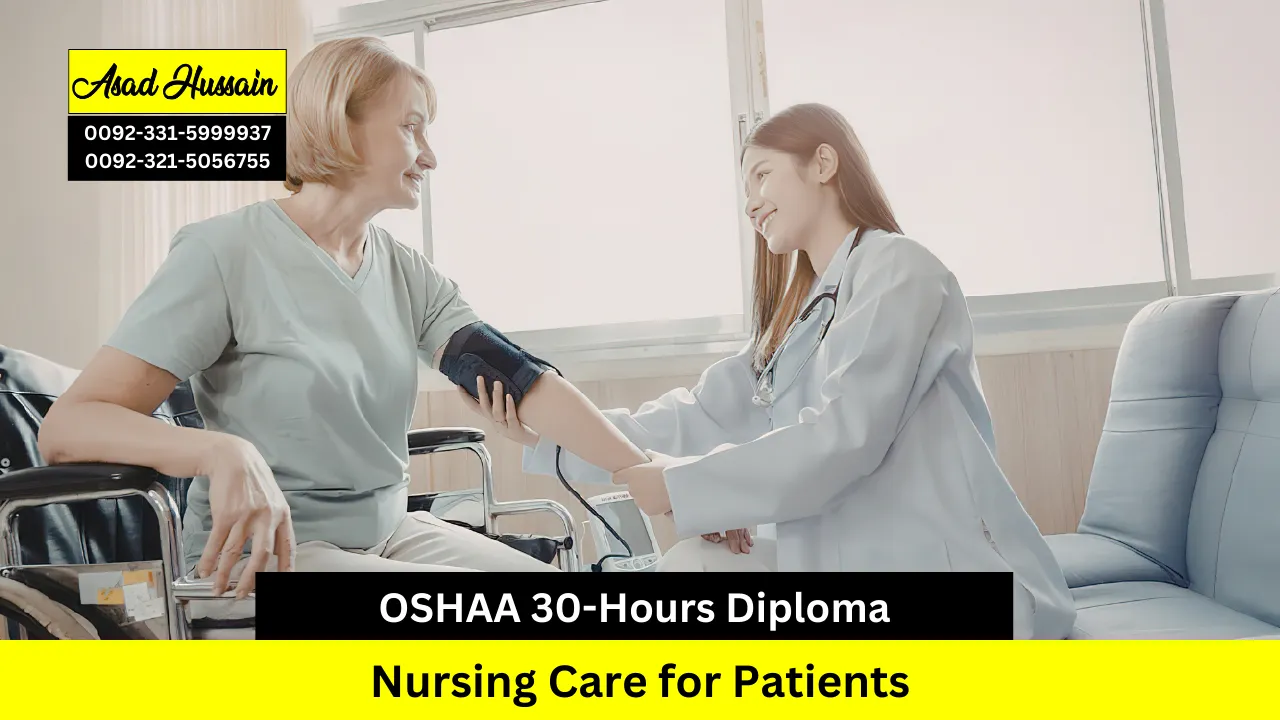
- Accurately measure and record temperature, pulse, respiration, and blood pressure.
- Identify normal versus abnormal readings and implement appropriate reporting protocols.
- Understand the clinical significance of continuous observations in preventing patient deterioration.
- Follow strict technical protocols for using diagnostic equipment and documenting digital results.
- Master the “Early Warning Score” (EWS) system to prioritize urgent clinical interventions.
Personal Hygiene, Mobility, and Basic Care Procedures
- Assist patients with personal hygiene, including toileting and grooming, while maintaining privacy.
- Support safe patient movement using correct positioning techniques and mobility aids.
- Implement preventative strategies to eliminate pressure injuries and skin breakdown.
- Maintain patient comfort and dignity during sensitive basic care activities.
- Evaluate the ergonomic safety of the care environment to protect both patient and practitioner.
Nutrition, Hydration, and Supporting Daily Living Activities
- Recognize the specialized nutritional and hydration needs of patients in various clinical settings.
- Assist with meal planning, assisted feeding, and the meticulous monitoring of fluid balance.
- Identify early clinical signs of malnutrition, dehydration, or dietary deficiencies.
- Promote patient independence while ensuring safety during daily care routines.
- Understand the link between balanced nutrition and accelerated wound healing.
Infection Prevention and Control in Clinical Settings
- Apply standard precautions and aseptic techniques to reduce the spread of healthcare-associated infections.
- Master the professional use of Personal Protective Equipment (PPE) and sterile cleaning protocols.
- Understand transmission routes, including airborne, droplet, and contact-based risks.
- Recognize the critical importance of maintaining a safe, sterile, and decontaminated care environment.
- Implement rigorous hand hygiene standards according to international clinical benchmarks.
Effective Communication and Compassionate Patient Interaction
- Communicate clearly and professionally with patients, families, and multidisciplinary teams.
- Utilize active listening and non-verbal body language to build therapeutic rapport.
- Adapt communication strategies for patients with sensory, cognitive, or speech difficulties.
- Build trust and offer emotional support through compassionate and professional engagement.
- Master the “SBAR” (Situation, Background, Assessment, Recommendation) communication tool for handovers.
Understanding Legal, Ethical, and Professional Responsibilities
- Understand the legal frameworks surrounding confidentiality, informed consent, and safeguarding.
- Recognize professional boundaries and the critical thresholds for escalating clinical concerns.
- Follow regulatory and workplace standards for precise record-keeping and incident reporting.
- Uphold ethical decision-making and professional accountability in complex care scenarios.
- Analyze the Duty of Candor and its role in maintaining transparency within the health sector.
Supporting Mental Health and Emotional Wellbeing in Patients
- Recognize the clinical signs of anxiety, depression, and confusion in hospitalized patients.
- Offer professional reassurance and companionship to alleviate emotional distress.
- Promote a supportive clinical environment that actively encourages mental wellbeing.
- Understand the bidirectional link between physical health conditions and emotional care needs.
- Implement de-escalation techniques for patients experiencing acute mental health episodes.
Target Audience
The OSHAA 30-Hours Diploma in Nursing Care for Patients is a specialized vocational program meticulously designed for healthcare assistants, clinical support workers, and aspiring nursing professionals who need to master the practical and ethical dimensions of patient care to ensure safety, dignity, and clinical excellence.
Healthcare Assistants and Clinical Support Workers
- Professionals working in acute hospital settings who require a deeper understanding of clinical monitoring.
- Support staff looking to refine their technical skills in recording vital signs and physiological data.
- Individuals aiming to improve their contribution to multidisciplinary medical teams through expert care.
- Staff members tasked with managing daily patient hygiene and mobility under clinical supervision.
- Workers seeking a recognized professional diploma to validate their hands-on nursing experience.
- Practitioners dedicated to reducing healthcare-associated risks through improved bedside techniques.
Residential and Geriatric Care Staff
- Caregivers in nursing homes who manage the complex needs of elderly patients with chronic conditions.
- Professionals focused on specialized dementia care and supporting patients with cognitive decline.
- Staff members responsible for preventing pressure sores and maintaining skin integrity in bedbound patients.
- Individuals looking to master nutritional and hydration monitoring for vulnerable populations.
- Care workers seeking to implement professional infection control standards within residential settings.
- Specialists aiming to provide high-quality palliative and end-of-life care with compassion and dignity.
Emergency and Community Health Workers
- First responders and community health aides who need a solid foundation in patient assessment.
- Staff members working in outpatient clinics who manage high volumes of patient observations.
- Professionals providing home-based nursing support who must act with high levels of autonomy.
- Individuals tasked with recognizing early signs of clinical deterioration in non-hospital settings.
- Workers focused on bridging the gap between emergency intervention and long-term recovery care.
- Practitioners seeking to improve their professional communication with families and medical boards.
Infection Control and Ward Safety Officers
- Staff members responsible for maintaining sterile environments and implementing PPE protocols.
- Professionals tasked with auditing ward safety and ensuring compliance with hygiene regulations.
- Individuals focused on the technical aspects of decontaminating clinical equipment and surfaces.
- Officers looking to lead internal training on standard precautions and transmission-based risks.
- Specialists dedicated to reducing the incidence of hospital-acquired infections through data-driven care.
- Experts seeking to manage clinical waste and hazardous materials according to safety standards.
Mental Health and Emotional Support Specialists
- Practitioners working in psychiatric wards who require skills in physical patient monitoring.
- Staff members focused on the holistic link between physical illness and emotional wellbeing.
- Professionals trained to recognize signs of acute anxiety or distress in clinical environments.
- Individuals dedicated to providing companionship and reassurance during long-term hospital stays.
- Specialists aiming to implement de-escalation techniques while maintaining patient safety.
- Caregivers focused on creating a therapeutic environment that encourages psychological recovery.
Nursing Students and Career Transitioners
- Aspiring nurses looking to gain a competitive edge before entering formal university degree programs.
- Professionals from IT or administrative backgrounds transitioning into frontline clinical roles.
- Individuals requiring a technical overview of the legal and ethical frameworks governing nursing.
- Students who need to master clinical documentation and professional record-keeping standards.
- Candidates looking for a comprehensive vocational foundation in anatomy and basic care procedures.
- Practitioners aiming to secure senior HCA or clinical lead positions through specialized training.
By completing this comprehensive program, you secure the clinical precision and specialized authority required to navigate the high-demand world of nursing, ensuring that every patient interaction is grounded in technical mastery, professional ethics, and unwavering compassion.overy and long-term physical wellbeing.