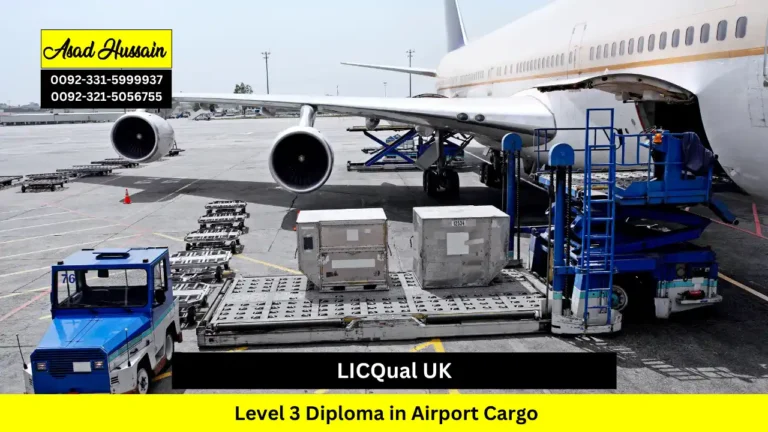
The LICQual UK Level 3 Diploma in Air Cargo and Logistics Management is a career-focused qualification designed to provide learners with a strong foundation in air cargo operations, logistics management, freight handling, and supply chain processes. As global trade and e-commerce continue to expand, the demand for skilled professionals who can efficiently manage the movement of goods through air transport and logistics networks is growing rapidly.
This diploma introduces learners to the key principles of air cargo management, transportation systems, warehouse operations, inventory control, freight documentation, and logistics coordination. It develops practical knowledge of how goods are transported, tracked, stored, and delivered while ensuring efficiency, compliance, and customer satisfaction throughout the supply chain.
Ideal for aspiring logistics professionals, aviation support personnel, freight forwarding staff, and individuals entering the transportation sector, the qualification equips learners with industry-relevant skills valued by employers worldwide. Upon completion, learners will have the knowledge and confidence to pursue rewarding opportunities in air cargo operations, logistics coordination, supply chain support, and transportation management, while building a pathway for further professional and academic progression in the logistics and aviation industries.
Program Highlights
Study Units
- Introduction to Air Cargo Industry
- Principles of Logistics and Supply Chain
- Air Cargo Operations & Handling
- Customer Service & Communication in Logistics
- Health, Safety & Security in Air Cargo
- Introduction to International Trade & Documentation
Entry Requirements
The following entry requirements are recommended to ensure learners can successfully complete the program:
- Age Requirement: Learners must be at least 16 years of age.
- Educational Background: A Level 2 qualification or equivalent is recommended. Applicants who have successfully completed secondary education or an equivalent qualification may apply.
- Professional Experience: No prior work experience is required. The qualification is suitable for beginners who wish to enter the air cargo and logistics sector.
- English Proficiency: Learners should have a good understanding of English and strong communication skills.
Course Learning Outcome
By the end of this course, learners will be able to:
1. Introduction to Air Cargo Industry
By the end of this unit, learners will be able to:
- Explain the structure and scope of the global air cargo industry and its role in international trade.
- Identify key stakeholders including airlines, freight forwarders, and regulatory bodies such as IATA and ICAO.
- Describe the evolution of air cargo services and emerging industry trends.
- Analyze the economic importance of air cargo in global supply chains.
- Demonstrate awareness of career pathways and professional opportunities in air cargo management.
- Apply industry terminology and concepts accurately in professional contexts.
2. Principles of Logistics and Supply Chain
By the end of this unit, learners will be able to:
- Define logistics and supply chain management within the context of global trade.
- Explain the integration of transportation, warehousing, and distribution in supply chain networks.
- Evaluate the role of multimodal transport in efficient cargo movement.
- Apply basic inventory management and demand forecasting techniques.
- Assess the impact of technology and digitalization on modern supply chains.
- Demonstrate understanding of sustainability and ethical practices in logistics.
3. Air Cargo Operations & Handling
By the end of this unit, learners will be able to:
- Describe the end‑to‑end process of air cargo acceptance, handling, and delivery.
- Demonstrate knowledge of Unit Load Devices (ULDs), packaging, and labeling requirements.
- Apply international safety and security standards in cargo handling operations.
- Explain documentation requirements including airway bills and cargo manifests.
- Evaluate the role of ground handling agents and warehouse operations in cargo flow.
- Identify best practices for minimizing risks and delays in air cargo operations.
4. Customer Service & Communication in Logistics
By the end of this unit, learners will be able to:
- Demonstrate effective communication skills in logistics and cargo service environments.
- Apply customer service strategies to enhance client satisfaction and loyalty.
- Handle customer inquiries, complaints, and service recovery professionally.
- Explain the importance of cultural awareness in international logistics communication.
- Use digital platforms and CRM tools to manage customer relationships.
- Evaluate the impact of service quality on organizational reputation and competitiveness.
5. Health, Safety & Security in Air Cargo
By the end of this unit, learners will be able to:
- Identify workplace health and safety regulations relevant to air cargo operations.
- Apply international aviation security standards to cargo screening and handling.
- Recognize hazardous materials and implement safe handling procedures.
- Demonstrate knowledge of emergency response and risk management protocols.
- Evaluate the importance of compliance with ICAO and IATA safety frameworks.
- Promote a culture of safety and security within air cargo organizations.
6. Introduction to International Trade & Documentation
By the end of this unit, learners will be able to:
- Explain the principles of international trade and its relationship with air cargo logistics.
- Interpret and apply Incoterms in cargo contracts and shipping agreements.
- Identify key trade documents including invoices, packing lists, and certificates of origin.
- Demonstrate knowledge of customs clearance procedures and compliance requirements.
- Evaluate the role of trade regulations and tariffs in global logistics.
- Apply documentation practices that ensure accuracy, legality, and efficiency in cargo movement.
Target Audience
The LICQual UK Level 3 Diploma in Air Cargo and Logistics Management is designed for learners who want to develop practical knowledge and skills in air cargo operations, freight management, logistics coordination, and supply chain processes. It is suitable for both beginners and professionals seeking to build a successful career in the logistics and transportation industry.
- Individuals interested in starting a career in air cargo, logistics, freight forwarding, or supply chain management.
- School leavers and recent graduates seeking an industry-relevant qualification to improve their employability.
- Learners who want to gain a strong understanding of air freight operations, cargo handling, and transportation systems.
- Logistics assistants and coordinators looking to enhance their knowledge of supply chain and distribution processes.
- Warehouse staff and inventory controllers seeking to develop their logistics and cargo management skills.
- Freight forwarding and shipping personnel who want to strengthen their understanding of international cargo operations.
- Aviation support staff involved in cargo handling, ground operations, and transportation services.
- Professionals working in transportation, distribution, and e-commerce sectors who wish to expand their logistics expertise.
- Individuals planning to transition into the logistics and supply chain industry from other sectors.
- Entrepreneurs and business owners involved in import-export, trade, shipping, or transportation activities.
- Learners interested in pursuing higher-level qualifications in logistics, supply chain management, aviation operations, or transport management.
- Anyone seeking an internationally recognised qualification that provides a foundation for career growth in the global air cargo and logistics industry.
This qualification offers an excellent starting point for learners who want to build practical skills, improve career prospects, and gain a comprehensive understanding of air cargo and logistics management in today’s fast-moving global economy.