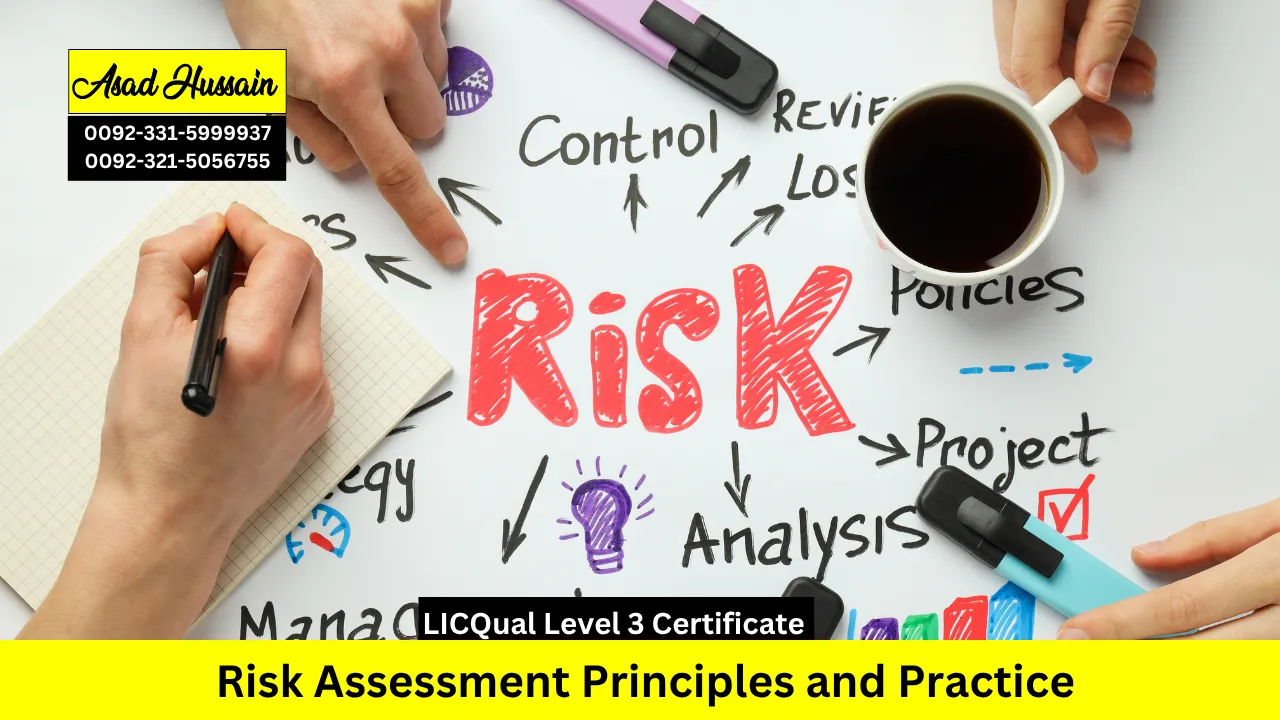
The LICQual Level 3 Certificate in Risk Assessment Principles and Practice is a professional qualification designed for individuals and professionals seeking to develop essential skills in identifying, evaluating, and managing risks in the workplace. This certification provides learners with comprehensive knowledge of risk assessment methodologies, health and safety regulations, and best practices to ensure a safe and compliant working environment across various industries.
The course covers key areas such as hazard identification, risk evaluation, control measures, reporting procedures, and legal requirements. Learners gain practical insights into applying systematic risk assessment processes, implementing preventative measures, and fostering a culture of safety within organizations. This enables organizations to minimize accidents, reduce liability, and enhance overall operational efficiency.
Ideal for health and safety officers, supervisors, managers, and employees responsible for workplace safety, this qualification enhances professional competence and prepares learners for roles involving risk management and compliance. It is also suitable for individuals seeking to build a career in occupational health and safety, environmental management, or operational risk control.
By completing the LICQual Level 3 Certificate in Risk Assessment Principles and Practice, learners acquire internationally recognized skills that are highly valued by employers. This certification equips professionals to assess risks effectively, implement safety measures, and ensure legal compliance, providing a strong foundation for career progression in health and safety, operational management, and risk assessment roles across industries worldwide.
Program Highlights
Study Units
To achieve,LICQual Level 3 Certificate in Risk Assessment Principles and Practice; Candidates must Complete the 6 Manadatory Units.
- Introduction to Risk Assessment
- Risk Identification
- Risk Assessment Techniques
- Risk Evaluation and Control
- Communication and Documentation
- Monitoring and Review of Risk Assessments
Entry Requirements
- Age Requirements: Candidates must be 18 years or older at the time of registration.
- Educational Background: Applicants should have at least a secondary education (high school diploma or equivalent).
- Language Proficiency:The course is delivered in English, so learners must demonstrate proficiency in English sufficient to understand course materials, engage in discussions, and complete assessments.
- Work Experience:While no formal work experience is mandatory, practical experience in workplace safety, health and safety management, or operational risk roles is highly recommended to fully benefit from the course.
Please ensure all criteria are met to facilitate a smooth admission process into this professional program.
Learning Outcomes
- Introduction to Risk Assessment
- Understand the purpose and importance of risk assessments in maintaining a safe working environment.
- Recognize the key principles and stages of risk assessment, including hazard identification, risk analysis, and control implementation.
- Demonstrate an ability to approach risk assessments systematically and in compliance with relevant regulations.
- Risk Identification
- Identify a wide range of workplace hazards, including physical, chemical, ergonomic, and psychosocial risks.
- Use various hazard identification techniques to detect potential risks in the work environment.
- Analyze workplace processes to identify hazards that may not be immediately visible or obvious.
- Risk Assessment Techniques
- Apply advanced risk assessment techniques such as qualitative, quantitative, and semi-quantitative methods to evaluate risks.
- Use tools like risk matrices, fault tree analysis, and bow-tie diagrams to assess and prioritize risks accurately.
- Select appropriate risk assessment methods based on the type of hazard and its potential impact on the workplace.
- Risk Evaluation and Control
- Evaluate the severity and likelihood of identified risks and prioritize them based on their potential impact.
- Implement control measures using the hierarchy of controls to effectively mitigate or eliminate risks.
- Demonstrate the ability to design and apply safety measures tailored to different types of workplace hazards.
- Communication and Documentation
- Create clear and comprehensive risk assessment reports that outline identified hazards, evaluated risks, and recommended actions.
- Communicate risk findings effectively to stakeholders, ensuring all parties understand the risks and proposed control measures.
- Ensure proper documentation and record-keeping to maintain a thorough risk assessment history for compliance purposes.
- Monitoring and Review of Risk Assessments
- Recognize the importance of regularly reviewing and updating risk assessments to ensure ongoing effectiveness.
- Monitor the impact of control measures and adapt risk assessments as necessary in response to changes in the workplace or new hazards.
- Conduct periodic reviews and audits to ensure the continued relevance and accuracy of risk assessments in maintaining a safe working environment.
Target Audience
This diploma is ideal for:
- Professionals working in health and safety roles, including safety officers, managers, and supervisors, who wish to enhance their expertise in risk assessment principles and practices.
- Individuals aspiring to enter risk management or safety compliance roles within various industries such as construction, manufacturing, healthcare, and hospitality.
- Employees who are responsible for identifying, evaluating, and managing workplace hazards and risk factors in their current or future positions.
- Those seeking to gain advanced knowledge of risk assessment techniques and how to apply them effectively to create safer work environments.
- Organizations aiming to develop the skills of their staff in conducting thorough risk assessments, ensuring compliance with safety regulations, and improving workplace safety.
- Learners who wish to develop clear communication skills to report risk assessment findings and recommendations to management and stakeholders.
- Professionals aiming to stay up-to-date with industry standards and regulatory requirements in health and safety management.