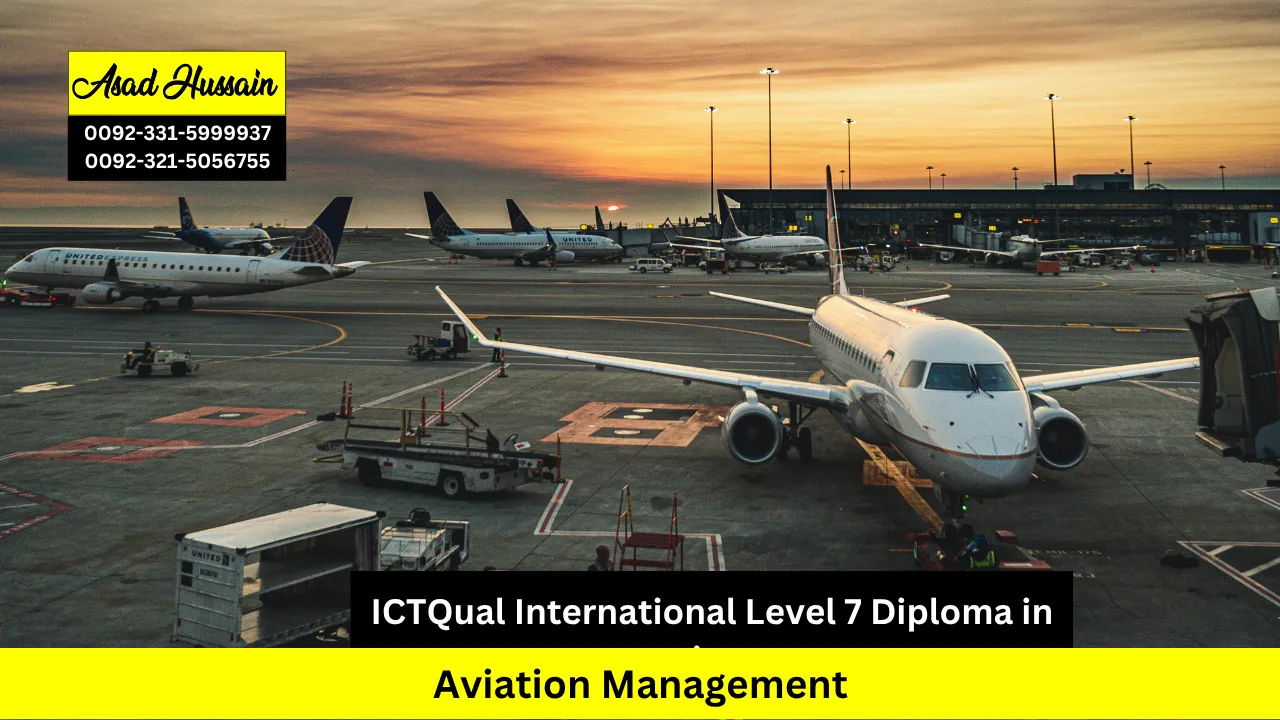
The ICTQual International Level 7 Diploma in Aviation Management is a prestigious, globally recognized qualification designed for professionals who aspire to reach the highest levels of leadership in the aviation industry. This advanced program builds on prior academic and professional experience, equipping learners with the strategic vision, analytical expertise, and executive management skills required to lead complex aviation organizations in a rapidly evolving global environment.
At Level 7, the diploma focuses on advanced concepts such as aviation policy and regulation, global strategy, crisis and risk management, sustainability, and innovation in aviation. Learners are trained to critically evaluate industry challenges, develop forward‑thinking solutions, and implement strategies that align with international standards. The program emphasizes leadership, governance, and decision‑making at the executive level, preparing graduates to influence the future of airlines, airports, and aviation authorities worldwide.
This qualification is ideal for senior managers, directors, entrepreneurs, and ambitious professionals who want to strengthen their expertise and credibility in aviation leadership. It is also a perfect progression route for graduates of Level 6 diplomas or equivalent qualifications who are ready to advance into executive roles. With its strong academic framework and practical industry relevance, the diploma bridges the gap between professional experience and postgraduate‑level study, making it highly valuable for both career advancement and academic progression.
By completing the ICTQual International Level 7 Diploma in Aviation Management, learners gain not only advanced leadership skills but also international recognition that enhances their career prospects across the globe. Graduates are fully prepared to take on senior executive positions, contribute to policy development, and drive innovation in one of the world’s most dynamic and fast‑growing industries.
Program Highlights
Mandatory Units
This qualification, the ICTQual International Level 7 Diploma in Aviation Management, consists of 6 mandatory units.
- Strategic Leadership and Global Aviation Governance
- Advanced Airline and Airport Strategic Management
- Aviation Risk, Safety, and Crisis Leadership
- Aviation Economics, Policy, and International Trade
- Innovation, Sustainability, and Future Trends in Aviation
- Dissertation / Applied Research Project in Aviation Management
To enroll in the ICTQual International Level 7 Diploma in Aviation Management, applicants are expected to meet the following criteria:
- Age Requirement: Learners should generally be 21 years or older at the time of enrollment.
- Educational Background: A Level 6 qualification in Aviation Management, Business, or a related field (such as the ICTQual Level 6 Diploma in Aviation Management or equivalent).
- Work Experience: Substantial professional experience in aviation, airport operations, airline management, or related industries is strongly preferred, as this is an advanced executive‑level program.
- English Language Proficiency: Since the program is delivered in English, learners must demonstrate strong written and spoken English skills, either through prior education or an equivalent qualification.
- Academic Readiness: Applicants should be capable of critical analysis, independent research, and strategic decision‑making, reflecting postgraduate‑level study expectations.
- Motivation and Commitment: Candidates must show a genuine interest in aviation leadership, innovation, and policy development, along with the ability to complete both theoretical and applied aspects of the program.
Learning Outcomes for the ICTQual International Level 7 Diploma in Aviation Management:
Strategic Leadership and Global Aviation Governance
By the end of this unit, learners will be able to:
- Critically evaluate the principles of strategic leadership in global aviation contexts.
- Analyse the role of governance frameworks in shaping airline and airport decision‑making.
- Assess the influence of international regulatory bodies on aviation governance.
- Apply leadership theories to complex aviation management challenges.
- Demonstrate the ability to lead diverse, multicultural teams in global aviation organisations.
- Develop strategies for ethical, transparent, and accountable leadership.
- Formulate governance models that align with international aviation standards.
Advanced Airline and Airport Strategic Management
By the end of this unit, learners will be able to:
- Evaluate advanced strategic management models in airline and airport operations.
- Analyse competitive positioning and market dynamics in the global aviation sector.
- Demonstrate understanding of long‑term planning for airline networks and airport infrastructure.
- Apply strategic tools to optimise operational efficiency and profitability.
- Assess the impact of mergers, alliances, and partnerships on aviation competitiveness.
- Develop strategies for sustainable growth in airline and airport management.
- Integrate strategic decision‑making with corporate objectives and stakeholder expectations.
Aviation Risk, Safety, and Crisis Leadership
By the end of this unit, learners will be able to:
- Critically analyse risk management frameworks in aviation.
- Evaluate the role of safety management systems in ensuring compliance and performance.
- Demonstrate advanced knowledge of crisis leadership in aviation emergencies.
- Apply risk assessment tools to identify and mitigate operational hazards.
- Assess the effectiveness of crisis communication strategies in aviation contexts.
- Develop leadership approaches for managing high‑pressure safety incidents.
- Formulate policies to strengthen organisational resilience and safety culture.
Aviation Economics, Policy, and International Trade
By the end of this unit, learners will be able to:
- Analyse the economic principles underpinning global aviation markets.
- Evaluate the impact of international trade agreements on aviation operations.
- Demonstrate understanding of aviation policy development at national and global levels.
- Assess the influence of economic cycles on airline and airport financial performance.
- Apply economic models to forecast aviation demand and growth.
- Critically examine the role of government intervention in aviation economics.
- Develop policy recommendations to support sustainable aviation growth.
Innovation, Sustainability, and Future Trends in Aviation
By the end of this unit, learners will be able to:
- Evaluate the role of innovation in shaping the future of aviation.
- Analyse the impact of digital transformation, automation, and AI on aviation operations.
- Demonstrate understanding of sustainability frameworks in aviation management.
- Assess the challenges of reducing carbon emissions and environmental impact.
- Apply innovative strategies to improve customer experience and operational efficiency.
- Recognise the importance of corporate social responsibility in aviation.
- Develop forward‑looking strategies to address emerging global aviation trends.
Dissertation / Applied Research Project in Aviation Management
By the end of this unit, learners will be able to:
- Formulate a research question addressing a complex aviation management issue.
- Critically evaluate research methodologies suitable for aviation studies.
- Collect, analyse, and interpret data to generate evidence‑based insights.
- Apply advanced research skills to solve real‑world aviation challenges.
- Demonstrate the ability to integrate theory with practice in aviation contexts.
- Present findings in a structured, academically rigorous, and professional format.
- Produce a dissertation or applied project that contributes to aviation management knowledge.
The ICTQual International Level 7 Diploma in Aviation Management is designed for ambitious professionals who aspire to reach the highest levels of leadership in the aviation industry. This advanced executive‑level qualification is ideal for those who already have significant experience or academic background in aviation and are ready to take on strategic, policy‑driven, and global leadership responsibilities.
1. Senior Aviation Executives
- Experienced professionals aiming for top‑tier executive roles in aviation
- Leaders preparing to oversee large‑scale airline or airport operations
- Individuals seeking advanced knowledge in global aviation strategy
- Professionals motivated to influence aviation policy and governance
- Executives wanting to strengthen decision‑making at the strategic level
- Aviation leaders preparing for international boardroom responsibilities
- Those aspiring to become CEOs, COOs, or Directors in aviation organizations
2. Graduates of Level 6 Diplomas
- Learners who have completed the ICTQual Level 6 Diploma in Aviation Management
- Students ready to progress to postgraduate‑level aviation studies
- Graduates seeking deeper expertise in aviation strategy and leadership
- Individuals motivated to specialize in global aviation governance
- Learners preparing for master’s or MBA programs in aviation or business
- Candidates aiming to enhance employability with an advanced qualification
- Ambitious learners seeking recognition at the highest academic level
3. Airline and Airport Directors
- Current directors or senior managers in airlines and airports
- Professionals responsible for strategic planning and operations
- Leaders handling complex challenges in safety, compliance, and growth
- Executives preparing for international aviation leadership roles
- Managers seeking to align with global aviation management standards
- Aviation professionals aiming to expand their influence globally
- Directors motivated to strengthen their credentials with a Level 7 diploma
4. Aviation Entrepreneurs and Innovators
- Individuals planning to establish or expand aviation‑related businesses
- Entrepreneurs seeking advanced insights into aviation finance and strategy
- Professionals motivated to innovate within the aviation sector
- Business leaders aiming to combine entrepreneurship with aviation expertise
- Learners preparing to launch consultancy or aviation service companies
- Innovators focused on sustainability and future aviation technologies
- Ambitious individuals determined to shape the future of aviation business
5. Policy Makers and Regulators
- Professionals working in aviation authorities or regulatory bodies
- Individuals aiming to influence aviation law, policy, and governance
- Leaders preparing to contribute to international aviation standards
- Policy makers seeking advanced knowledge of global aviation frameworks
- Regulators motivated to strengthen compliance and safety expertise
- Professionals aiming to bridge the gap between policy and operations
- Learners preparing for senior roles in government or aviation agencies
6. International Aviation Professionals
- Learners from different countries seeking a globally recognized qualification
- Professionals preparing for careers in multinational aviation organizations
- Individuals motivated to meet international aviation leadership standards
- Learners interested in networking with global aviation peers
- Students aiming to pursue higher studies abroad in aviation or business
- Professionals seeking mobility and recognition across borders
- Aviation leaders preparing for global career advancement
7. Future Aviation Thought Leaders
- Ambitious individuals aspiring to shape the future of global aviation
- Professionals motivated to influence aviation strategy and innovation
- Learners developing critical thinking and advanced research skills
- Future leaders preparing to contribute to aviation sustainability
- Individuals aiming to drive change in safety, operations, and governance
- Professionals determined to become global aviation consultants or advisors
- Learners seeking to leave a lasting impact on the aviation industry