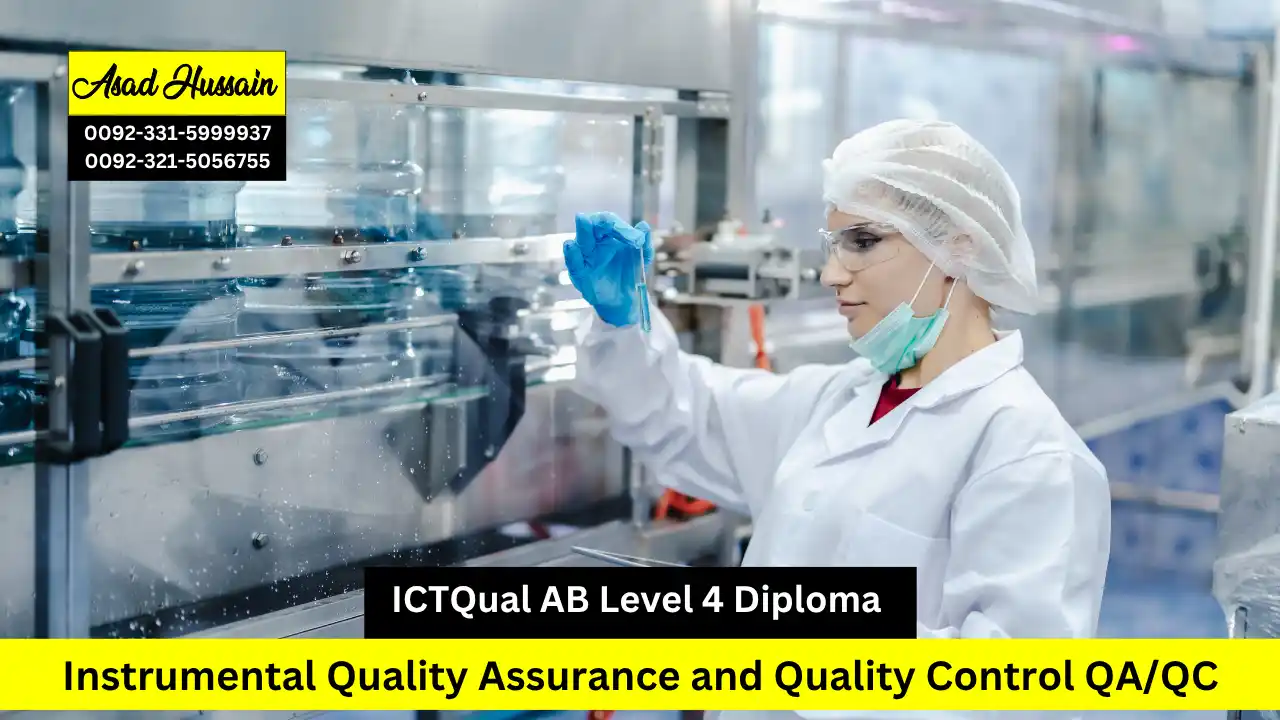
The ICTQual AB Level 4 Diploma in Instrumental Quality Assurance and Quality Control (QA/QC) is an advanced qualification designed to equip learners with comprehensive technical and managerial expertise in quality assurance, inspection, and instrumentation control. In today’s globally competitive industrial landscape, maintaining precision, safety, and compliance with international standards is essential for operational excellence. This diploma Quality Assurance program focuses on developing advanced skills in quality auditing, process monitoring, instrumentation verification, and documentation control, making it ideal for professionals aiming to excel in QA/QC and instrumentation management roles.
ICTQual AB Level 4 Diploma in Instrumental Quality Assurance and Quality Control QA/QC provides a solid understanding of advanced quality control methodologies, including calibration management, inspection planning, and performance evaluation of process instruments. Learners will explore how to apply quality assurance frameworks to complex industrial systems, ensuring that every instrument operates accurately and consistently. Through practical assignments and case studies, participants gain the analytical and technical proficiency required to perform effective QA/QC operations across industries such as oil and gas, Quality Assurance ,power generation, petrochemical, and manufacturing.
The ICTQual AB Level 4 Diploma in Instrumental Quality Assurance and Quality Control (QA/QC), learners will gain hands-on experience in using testing tools, managing inspection schedules, and performing audits in compliance with global standards like ISO 9001, ISO/IEC 17025, and API specifications. The course promotes strong decision-making and problem-solving abilities, ensuring that graduates can identify, analyze, and resolve quality issues effectively.
This qualification also emphasizes the integration of advanced instrumentation technologies, inspection software, and quality management systems. Learners develop critical competencies in risk assessment, data interpretation, and continuous improvement strategies that enhance process reliability and product quality. With a strong focus on real-world applications, the course bridges theoretical knowledge with practical industry demands.
Program Highlights
Mandatory Units
- Developing and Applying ITPs in Instrumentation Projects
- Inspection Checklists and Documentation for Compliance
- Material Receiving, Handling, and Preservation Procedures
- Application of NEC‑250 Grounding and NEMA VE‑1/VE‑2 Cable Tray Standards
- Installation Practices for Conduits (RMS, FMT, RGS, IMT – NEC Articles 344–400)
- Intermediate Loop Checking, Testing, and Commissioning Techniques
The ICTQual AB Level 4 Diploma in Instrumental Quality Assurance and Quality Control (QA/QC) is designed to provide learners with advanced technical knowledge and practical expertise in the field of industrial instrumentation, inspection, and quality assurance. To ensure that learners are adequately prepared to meet the academic and professional demands of the course, specific entry requirements have been established.
Age Requirements
- Applicants must be at least 18 years of age at the time of enrollment.
- This ensures that learners possess the maturity, focus, and professional responsibility necessary to handle complex instrumentation systems, adhere to safety protocols, and effectively participate in quality inspection and assurance processes across industrial settings.
Educational Requirements
- Learners should have successfully completed secondary education or an equivalent qualification, such as GCSEs, a Level 3 Diploma, or a recognized vocational certificate.
- A background in science, mathematics, physics, or engineering is strongly recommended, as these subjects provide the analytical and technical foundation required for understanding advanced concepts in instrumentation, calibration, and process control covered in the course.
Professional Experience
- While previous work experience is not mandatory, candidates with practical experience in instrumentation, electrical, mechanical, or quality assurance fields will have an advantage.
- Those currently employed as QA/QC Inspectors, Instrument Technicians, or Process Operators are encouraged to apply. Practical exposure to inspection procedures, maintenance operations, or calibration practices will enhance a learner’s ability to apply theoretical knowledge to real-world scenarios effectively.
English Language Proficiency
- Since the program is delivered in English, learners must demonstrate adequate proficiency in reading, writing, listening, and speaking English.
- Applicants whose first language is not English should provide evidence of language competence equivalent to IELTS Level 5.0 or higher. This ensures they can comprehend technical documentation, participate in discussions, and complete written assignments accurately throughout the course.
The ICTQual AB Level 4 Diploma in Instrumental Quality Assurance and Quality Control (QA/QC) also serves as a progression pathway to higher-level qualifications such as the ICTQual AB Level 5 Diploma in Instrumentation and Quality Management.
The ICTQual AB Level 4 Diploma in Instrumental Quality Assurance and Quality Control (QA/QC) is a professionally designed qualification aimed at developing the advanced technical, analytical, and procedural skills necessary to ensure precision, compliance, and reliability in industrial instrumentation projects. This program Quality Assurance builds upon the foundational principles of instrumentation and quality assurance, preparing learners to apply international standards and inspection methodologies in real-world industrial environments.
Developing and Applying ITPs in Instrumentation Projects
• Develop comprehensive Inspection and Test Plans (ITPs) for instrumentation projects based on project specifications, codes, and standards.
• Evaluate inspection requirements and establish appropriate checkpoints to ensure compliance with QA/QC standards during each project phase.
• Apply ITPs effectively to monitor and verify installation, calibration, and testing processes for control instruments and systems.
• Coordinate with project teams and quality inspectors to maintain inspection traceability, documentation, and approval records.
• Implement continuous improvement strategies by reviewing and updating ITPs in response to non-conformities and field observations.
Inspection Checklists and Documentation for Compliance
• Design and utilize instrumentation inspection checklists to assess conformance to project specifications and international quality standards.
• Prepare, review, and maintain detailed inspection documentation for installation, loop checking, and calibration procedures.
• Verify the accuracy and completeness of QA/QC records, ensuring traceability and proper filing in accordance with client and regulatory requirements.
• Demonstrate competence in conducting visual and functional inspections using standardized reporting templates.
• Apply effective documentation control systems to support internal and external quality audits in industrial environments.
Material Receiving, Handling, and Preservation Procedures
• Inspect and verify materials, instruments, and equipment upon receipt to ensure compliance with approved data sheets and purchase orders.
• Apply correct handling and preservation techniques to prevent damage, corrosion, or contamination of instrumentation materials.
• Implement warehouse management and material control systems to maintain traceability and proper documentation of received items.
• Evaluate supplier material certificates, calibration records, and inspection reports for conformity with QA/QC requirements.
• Ensure adherence to project specifications and international standards during material handling and storage operations.
Application of NEC-250 Grounding and NEMA VE-1/VE-2 Cable Tray Standards
• Interpret and apply NEC-250 grounding standards to ensure proper earthing and electrical safety of instrumentation systems.
• Implement NEMA VE-1 and VE-2 standards in the design, installation, and inspection of cable tray systems for industrial applications.
• Identify potential grounding and cable routing issues and apply corrective actions to maintain compliance with industry codes.
• Conduct inspection and verification of grounding connections and cable tray supports for safety and operational efficiency.
• Integrate grounding and cable management best practices into QA/QC inspection procedures for electrical and instrumentation systems.
Installation Practices for Conduits (RMS, FMT, RGS, IMT – NEC Articles 344–400)
• Interpret and apply NEC Articles 344–400 to ensure proper installation and inspection of conduit systems in instrumentation projects.
• Verify conduit routing, support, bending radius, and termination in compliance with project drawings and NEC requirements.
• Conduct inspections for conduit material types including RMS, FMT, RGS, and IMT to ensure durability and performance.
• Implement safe work practices and quality control procedures during conduit installation to minimize risks and ensure long-term reliability.
• Prepare inspection and testing reports verifying conduit installation quality and adherence to regulatory standards.
Intermediate Loop Checking, Testing, and Commissioning Techniques
• Conduct loop checking and functional testing to verify instrument signal integrity and proper system operation before commissioning.
• Apply systematic testing procedures to validate instrument calibration, wiring continuity, and control logic accuracy.
• Identify and troubleshoot faults detected during loop checking and pre-commissioning phases.
• Document loop check results, instrument calibration data, and commissioning activities following QA/QC standards.
• Collaborate with multidisciplinary teams to ensure seamless system integration and operational readiness during final commissioning.
The ICTQual AB Level 4 Diploma in Instrumental Quality Assurance and Quality Control (QA/QC) ensures that learners gain the practical and theoretical expertise required to perform high-level QA/QC activities in instrumentation projects. Graduates of this qualification will be able to develop and implement inspection plans, apply international standards, and lead commissioning procedures with confidence and precision. This program Quality Assurance not only enhances technical competence but also prepares professionals to contribute effectively to industrial safety, reliability, and quality assurance excellence across various engineering sectors.
The ICTQual AB Level 4 Diploma in Instrumental Quality Assurance and Quality Control (QA/QC) is an internationally recognized qualification designed to advance learners’ expertise in instrumentation quality assurance, inspection, and control processes. As industries increasingly emphasize precision, compliance, and reliability, skilled QA/QC professionals play a crucial role in ensuring that instrumentation systems meet global standards and perform safely and efficiently.
Instrumentation QA/QC Inspectors and Engineers
• Professionals currently working or aspiring to work as QA/QC Inspectors or Engineers in instrumentation and process industries.
• Individuals responsible for verifying installation, calibration, and performance compliance of instruments and control systems.
• Technicians seeking to strengthen their understanding of inspection procedures, testing documentation, and project specifications.
• Learners aiming to ensure consistent quality and adherence to international standards in industrial instrumentation projects.
• Professionals dedicated to maintaining operational integrity and optimizing system performance through structured QA/QC practices.
Industrial Inspection and Testing Technicians
• Individuals involved in the inspection and testing of instrumentation equipment, control panels, and electrical systems.
• Professionals ensuring quality verification during different project phases, including installation, loop checking, and commissioning.
• Learners developing practical skills in conducting inspection tests, preparing reports, and identifying non-conformities.
• Technicians committed to implementing preventive quality measures and maintaining calibration accuracy.
• Professionals aiming to uphold safety and quality compliance in oil and gas, manufacturing, and process industries.
Process and Quality Control Engineers
• Engineers and technicians responsible for monitoring, analyzing, and improving process quality within industrial operations.
• Professionals applying QA/QC principles to ensure accurate measurement, control, and reporting of process variables.
• Individuals seeking to enhance their understanding of ISO, ASME, and ASTM standards in instrumentation projects.
• Learners focusing on integrating process control data into continuous improvement and risk management initiatives.
• Engineers dedicated to optimizing production quality while maintaining regulatory and customer compliance.
Project and Construction QA/QC Coordinators
• Supervisors and coordinators overseeing instrumentation QA/QC activities during construction, installation, and commissioning phases.
• Professionals managing inspection schedules, documentation control, and coordination with client and contractor QA/QC teams.
• Individuals ensuring that all instruments and systems are installed, tested, and documented according to project requirements.
• Learners gaining expertise in reviewing Inspection Test Plans (ITPs), checklists, and material compliance certificates.
• Coordinators committed to enhancing efficiency, minimizing rework, and ensuring project quality assurance deliverables are met.
Maintenance, Calibration, and Reliability Specialists
• Technicians and engineers engaged in maintaining, testing, and calibrating instrumentation systems for performance reliability.
• Professionals using advanced tools and procedures to ensure measurement accuracy and system dependability.
• Learners seeking to implement quality-focused maintenance strategies aligned with international QA/QC standards.
• Individuals enhancing their troubleshooting and diagnostic capabilities in industrial environments.
• Specialists committed to promoting long-term equipment reliability, operational safety, and quality consistency.
Career-Focused Learners and Future QA/QC Professionals
• Individuals aspiring to establish or advance their careers in Instrumentation Quality Assurance and Quality Control (QA/QC).
• Learners preparing for roles such as QA/QC Inspector, Calibration Technician, or Instrumentation Engineer across global industries.
• Professionals motivated to gain hands-on experience in inspection methods, documentation, and testing protocols.
• Individuals aiming to build a career in industries such as oil and gas, petrochemicals, power generation, and manufacturing.
• Learners looking to progress to higher-level qualifications, such as the ICTQual AB Level 5 Diploma in Instrumentation and Control Systems QA/QC, for advanced specialization.
The ICTQual AB Level 4 Diploma in Instrumental Quality Assurance and Quality Control (QA/QC) is ideal for professionals committed to achieving excellence in instrumentation inspection, compliance, and project quality management. Through a balanced approach of theory and practical application, this qualification empowers learners to perform at a higher professional standard in industrial environments where accuracy, safety, and quality are essential. Upon completion, graduates will be equipped to contribute effectively to quality assurance systems, lead inspection teams, and uphold global standards in complex instrumentation projects across the industrial sector.