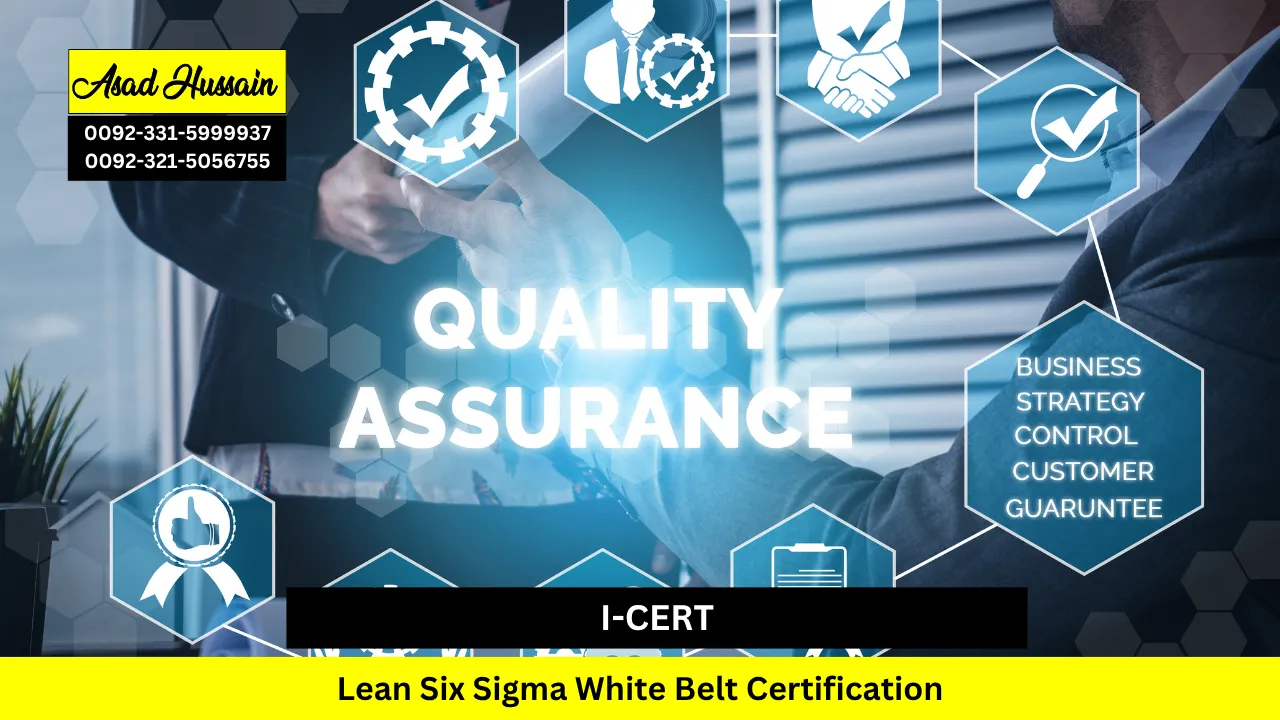
I-CERT Lean Six Sigma White Belt Certification is an entry-level professional qualification designed to introduce Learners to the fundamental concepts of Lean Six Sigma, process improvement, and quality management. It provides a strong foundation for understanding how organisations improve efficiency, reduce waste, enhance quality, and achieve operational excellence through structured improvement methodologies.
This certification covers the essential principles of Lean and Six Sigma, including process improvement concepts, waste identification, variation reduction, continuous improvement practices, problem-solving approaches, and the importance of data-driven decision-making. Learners gain awareness of how Lean Six Sigma methodologies are applied to improve business processes across different industries.
The course is ideal for beginners, students, employees, team members, and professionals who want to develop basic knowledge of Lean Six Sigma before progressing to higher-level qualifications such as Yellow Belt, Green Belt, or Black Belt certifications. It is suitable for individuals who want to understand the role of continuous improvement in modern organisations.
By completing the I-CERT Lean Six Sigma White Belt Certification, Learners gain essential knowledge of Lean Six Sigma principles, improvement terminology, and quality management practices, enabling them to support process improvement initiatives and contribute effectively to organisational success.
Program Highlights
Study Units
This qualification, the I-CERT Lean Six Sigma White Belt Certification, comprises three modules. To successfully achieve the certification, learners are required to complete an online multiple-choice question (MCQ) assessment, designed to evaluate their understanding of Lean and Six Sigma awareness and fundamental concepts, with a minimum passing score of 60%.
- What Is Six Sigma?
- Six Sigma History and Application
- Other Process Improvement and Quality Methods
Entry Requirements
The I-CERT Lean Six Sigma White Belt Certification is designed as an entry-level qualification and is accessible to individuals who want to develop a basic understanding of Lean Six Sigma principles and continuous improvement practices.
- Age Requirement: Learners should generally be 16 years or above
- Educational Background: No specific academic qualification is required; a basic educational background is recommended
- Professional Experience: Extensive experience in senior management, quality leadership, or process improvement roles is essential
- English Proficiency: Learners should have a good understanding of English and strong communication skills.
Learning Outcomes
Upon successful completion of this certification, learners will be able to demonstrate knowledge and understanding of fundamental Lean Six Sigma concepts in line with internationally recognized quality management practices.
What Is Six Sigma?
Learners will be able to:
- Define the concept and purpose of Six Sigma within modern organizations
- Explain key principles such as variation reduction, defect prevention, and process improvement
- Identify basic Six Sigma terminology, including DMAIC, defects, and process capability
- Recognize the roles and responsibilities within a Six Sigma framework (e.g., White Belt, Yellow Belt, Green Belt)
Six Sigma History and Application
Learners will be able to:
- Describe the historical development of Six Sigma and its evolution across industries
- Identify key organizations and contributors involved in the advancement of Six Sigma methodologies
- Explain how Six Sigma is applied in different sectors, including manufacturing, healthcare, and services
- Understand the benefits of Six Sigma implementation in improving quality, efficiency, and customer satisfaction
Other Process Improvement and Quality Methods
Learners will be able to:
- Identify and describe complementary methodologies such as Lean, Kaizen, Total Quality Management (TQM), and Continuous Improvement
- Compare Six Sigma with other quality and process improvement approaches
- Recognize how Lean principles integrate with Six Sigma to eliminate waste and improve process flow
- Demonstrate awareness of when and how different improvement methods can be applied in organizational contexts
Target Audience
The I-CERT Lean Six Sigma White Belt Certification is designed for individuals who want to gain a basic understanding of Lean Six Sigma principles, quality improvement, and continuous improvement practices.
• Beginners who want to start learning Lean Six Sigma methodologies
• Students and graduates seeking professional development skills
• Employees who want to understand process improvement concepts within their workplace
• Team members involved in quality, efficiency, or improvement activities
• Supervisors and junior managers looking to improve workplace processes
• Professionals from any industry who want awareness of Lean and Six Sigma practices
• Individuals preparing to progress towards Yellow Belt, Green Belt, or higher-level Lean Six Sigma certifications
• Business professionals interested in reducing waste, improving efficiency, and enhancing quality performance
• Organisations seeking to provide Lean Six Sigma awareness training to their employees
This course is ideal for Learners who want to build a strong foundation in Lean Six Sigma concepts and understand how continuous improvement methods help organisations achieve better performance and operational excellence.