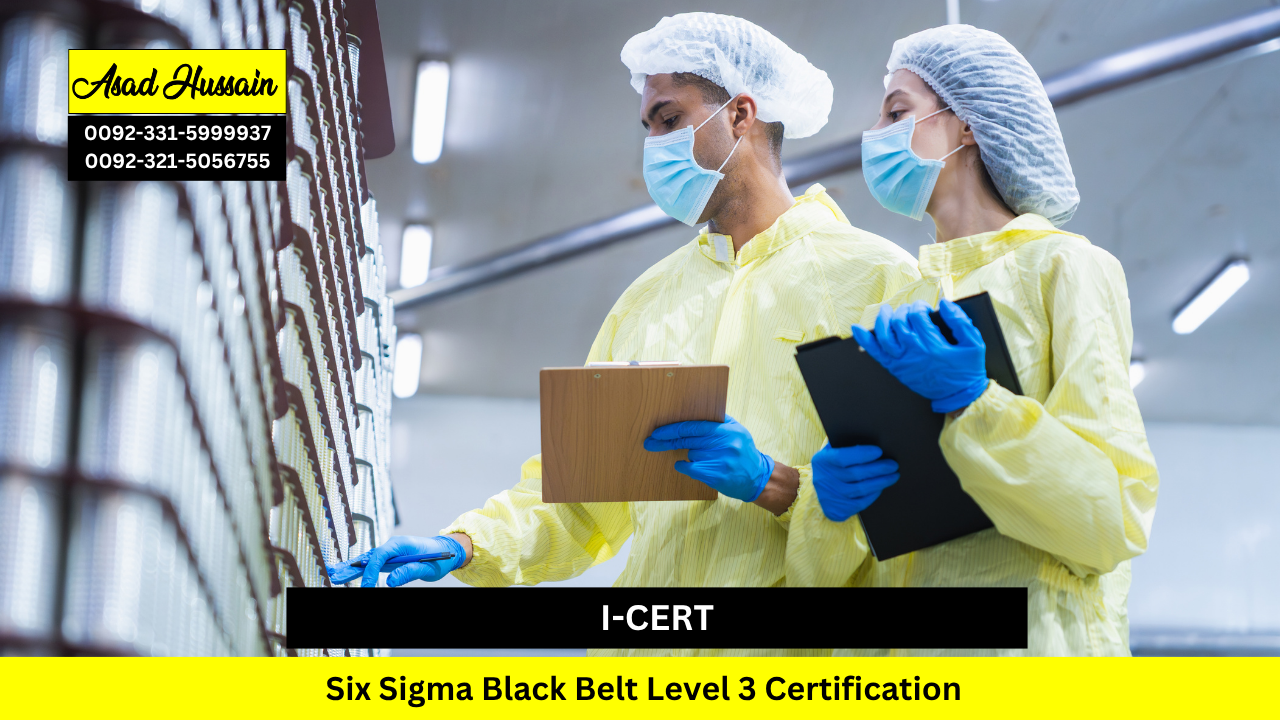
I-CERT Six Sigma Black Belt Level 3 Certification is an advanced professional qualification designed for experienced Six Sigma practitioners who want to achieve a higher level of expertise in process improvement, quality management, and strategic operational excellence. It focuses on advanced methodologies that enable professionals to lead complex projects, optimise business performance, and deliver sustainable improvements.
This certification develops deeper knowledge of advanced Six Sigma tools, statistical analysis, process optimisation techniques, risk management, and data-driven decision-making. Learners gain the capability to manage high-impact improvement programmes, evaluate organisational challenges, and implement effective solutions aligned with business objectives.
The course is ideal for senior quality professionals, Six Sigma practitioners, project managers, operational leaders, and consultants seeking to enhance their leadership capabilities and technical expertise. It prepares individuals to take greater responsibility for organisational transformation and continuous improvement initiatives.
By completing the I-CERT Six Sigma Black Belt Level 3 Certification, Learners demonstrate advanced competence in Six Sigma practices and strengthen their ability to drive innovation, efficiency, and measurable business improvements across diverse industries.
Program Highlights
Study Units
The I-CERT Six Sigma Black Belt Level 3 Certification offers 180–200 hours of advanced learning through online self-paced modules or instructor-led workshops. The program includes 150 MCQs to reinforce key concepts, ensuring practical mastery and readiness for real-world process improvement projects.
- Advanced Six Sigma Overview & Strategic Role
- Enterprise-Level Process Management
- Advanced DMAIC Methodology
- Advanced Data Collection & Measurement Systems
- Advanced Statistical Analysis Techniques
- Root Cause Analysis & Problem-Solving Tools
- Process Optimization & Lean Integration
- Change Management & Leadership Skills
- Risk Management & Process Control
- Project Selection & Financial Impact Analysis
- Sustainability & Continuous Improvement Culture
- Capstone Project & Practical Application
Entry Requirements
The I-CERT Lean Six Sigma Black Belt Certification is an advanced-level qualification designed for professionals who have a strong understanding of Lean Six Sigma principles and want to develop expertise in leading complex improvement projects.
- Age Requirement:Learners should generally be 18 years or above
- Educational Background:A recognised qualification or equivalent professional experience is recommended
- Professional Experience:Extensive experience in senior management, quality leadership, or process improvement roles is essential
- English Proficiency: Learners should have a good understanding of English and strong communication skills.
Learning Outcomes
Upon successful completion of this certification, learners will be able to:
Advanced Six Sigma Overview & Strategic Role
- Understand the strategic importance of Six Sigma in organizational performance.
- Analyze business processes to identify areas for improvement.
- Align Six Sigma initiatives with organizational goals and KPIs.
- Develop a framework for enterprise-level process excellence.
Enterprise-Level Process Management
- Map and manage complex organizational processes efficiently.
- Apply process governance and control frameworks.
- Optimize cross-functional workflows for maximum efficiency.
- Ensure alignment of process outcomes with strategic objectives.
Advanced DMAIC Methodology
- Apply Define, Measure, Analyze, Improve, Control (DMAIC) at advanced levels.
- Identify and prioritize critical process improvement opportunities.
- Use quantitative and qualitative analysis to support decisions.
- Implement sustainable solutions for long-term process optimization.
Advanced Data Collection & Measurement Systems
- Design robust data collection strategies for accurate insights.
- Evaluate measurement system reliability and validity.
- Use data to identify process variation and inefficiencies.
- Implement metrics and KPIs to monitor performance.
Advanced Statistical Analysis Techniques
- Perform complex statistical analysis for process evaluation.
- Apply regression, ANOVA, and hypothesis testing effectively.
- Interpret data to drive informed decisions.
- Identify trends, patterns, and correlations to improve outcomes.
Root Cause Analysis & Problem-Solving Tools
- Identify root causes of process failures systematically.
- Apply advanced problem-solving tools like Fishbone and 5 Whys.
- Develop corrective and preventive actions.
- Facilitate team-based problem-solving sessions.
Process Optimization & Lean Integration
- Integrate Lean principles with Six Sigma for process efficiency.
- Eliminate waste and non-value-added activities.
- Optimize process flow for higher productivity and quality.
- Implement continuous improvement initiatives at the enterprise level.
Change Management & Leadership Skills
- Lead change initiatives effectively across teams and departments.
- Develop influential leadership skills for process improvement.
- Manage resistance to change and foster acceptance.
- Create a culture that supports innovation and operational excellence.
Risk Management & Process Control
- Identify and assess potential risks in processes.
- Implement process control mechanisms to mitigate risks.
- Monitor processes for consistency and compliance.
- Use risk-based approaches to prioritize improvement efforts.
Project Selection & Financial Impact Analysis
- Select high-impact projects aligned with business strategy.
- Evaluate financial benefits and ROI of process improvement projects.
- Prioritize initiatives based on strategic value and feasibility.
- Measure and report project outcomes to stakeholders.
Sustainability & Continuous Improvement Culture
- Foster a continuous improvement mindset across the organization.
- Implement sustainable process improvement practices.
- Encourage employee engagement in process excellence initiatives.
- Monitor and sustain long-term performance improvements.
Capstone Project & Practical Application
Validate project impact on process performance and organizational goals.
Apply all Six Sigma concepts in a real-world project.
Demonstrate practical problem-solving and leadership skills.
Present results and insights to management and stakeholders.
Apply innovation and creative problem-solving tools.
Target Audience
The I-CERT Six Sigma Black Belt Level 3 Certification is designed for experienced professionals who want to advance their expertise in Six Sigma leadership, strategic process improvement, and organisational transformation.
• Senior Six Sigma practitioners seeking to enhance their advanced improvement capabilities
• Black Belt professionals aiming to strengthen their knowledge of complex Six Sigma methodologies
• Quality managers and continuous improvement leaders responsible for strategic performance enhancement
• Project managers leading large-scale process optimisation and transformation projects
• Operations managers focused on improving productivity, efficiency, and business performance
• Engineers and technical specialists involved in advanced process analysis and optimisation
• Consultants supporting organisations with Lean Six Sigma and operational excellence initiatives
• Professionals preparing for senior leadership roles in quality management and business improvement
• Individuals aspiring to progress towards Master Black Belt and expert-level Six Sigma qualifications
This course is ideal for professionals who want to lead advanced improvement programmes, apply sophisticated Six Sigma techniques, and create measurable organisational value.