Master Hand Safety Skills with Diploma in Injury Prevention
The OSHAA 30-Hours Professional Diploma in Hand Safety and Injury Prevention is a professionally designed training programme focused on reducing workplace injuries and strengthening safety culture through effective hand protection practices. This course delivers a structured and practical learning experience that helps individuals understand common hand hazards, risk factors, and injury mechanisms across different working environments. Learners gain essential knowledge of workplace safety responsibilities, hazard identification, safe work procedures, and preventive strategies that support safer operations. The programme is not Ofqual regulated and is developed to meet modern industry needs, making it suitable for individuals seeking strong foundational and professional-level competence in hand safety and injury prevention.
This diploma offers a balanced blend of theory and practical application, enabling learners to build confidence in recognising risks, implementing control measures, and promoting injury prevention strategies in real working environments. Participants will explore workplace risk assessments, personal protective equipment (PPE) selection, accident prevention methods, behavioural safety approaches, and safety awareness systems. The course structure supports skill development that aligns with professional workplace expectations and global safety practices. Learners also gain knowledge that supports progression toward various industry-recognised certifications and professional diplomas in occupational safety, workplace health management, and risk prevention disciplines.
OSHAA 30-Hours Professional Diploma in Hand Safety and Injury Prevention also supports long-term professional development by strengthening safety leadership skills and compliance awareness. The programme builds a strong professional foundation for individuals seeking career growth within safety management, industrial safety, construction safety, manufacturing safety, and health and safety advisory roles. Learners develop transferable competencies that support access to further certifications and professional diplomas in occupational health, safety management systems, industrial risk control, and injury prevention leadership. This structured learning pathway helps professionals enhance credibility, workplace value, and long-term career sustainability within the global safety and health sector.
Program Highlights
Study Units
- Introduction to Hand Safety and Occupational Risk (3 hours)
- Anatomy of the Hand and Common Injury Mechanisms (3 hours)
- Types of Hand Injuries: Causes and Consequences (4 hours)
- Hazard Identification and Risk Assessment Techniques (6 hours)
- Personal Protective Equipment (PPE) for Hand Protection (3 hours)
- Ergonomics and Repetitive Strain Injury Prevention (5 hours)
- Safety Procedures for Tools, Machinery, and Handling (4 hours)
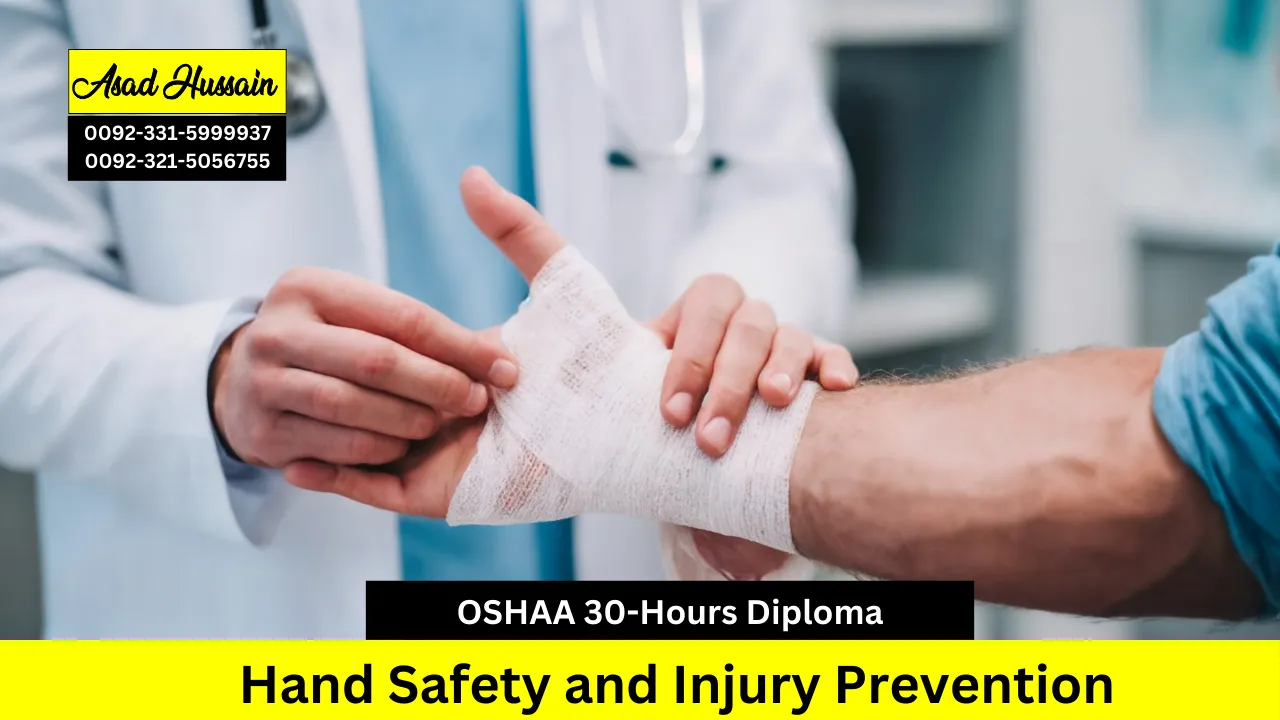
- First Aid and Immediate Response for Hand Injuries (2 hours)
To ensure an effective and engaging learning experience, the OSHAA 30-Hours Professional Diploma in Hand Safety and Injury Prevention is designed with accessible entry requirements suitable for a wide range of learners.
- Age Requirement: Learners should be at least 18 years of age at the time of enrolment to ensure readiness for professional-level safety concepts and workplace responsibilities.
- Educational Background: A basic educational background is recommended. Individuals holding or pursuing related diplomas or certificates such as workplace safety awareness certificates, occupational health and safety diplomas, industrial safety certificates, construction safety training, manufacturing safety courses, or risk assessment certifications may find the course particularly beneficial.
- Language Proficiency: Learners should have a reasonable level of English language proficiency to understand course materials, follow instructions, and participate effectively in learning activities.
- Work Experience: While prior work experience is not mandatory, individuals with experience in industrial, construction, manufacturing, maintenance, logistics, or safety-related roles will be able to relate the course content more effectively to real workplace scenarios.
Overall, these entry requirements ensure the course remains inclusive while supporting learners in gaining practical, career-relevant knowledge and professional competence in hand safety and injury prevention.
Learning Outcomes
Introduction to Hand Safety and Occupational Risk (3 Hours)
- Understand the importance of hand safety in occupational environments
- Identify the most common workplace settings where hand injuries occur
- Explore the financial, physical, and operational consequences of hand injuries
- Recognise the role of training and awareness in reducing injury risks
Anatomy of the Hand and Common Injury Mechanisms (3 Hours)
- Learn the basic anatomy and functional structure of the hand
- Understand how bones, tendons, nerves, and muscles interact during work tasks
- Identify mechanical, thermal, chemical, and biological forces that cause hand injuries
- Explore how different job roles expose hands to specific injury risks
Types of Hand Injuries: Causes and Consequences (4 Hours)
- Identify common hand injuries such as lacerations, crush injuries, burns, fractures, and amputations
- Understand short- and long-term consequences of hand injuries on functionality and productivity
- Analyse real-world case examples and incident reports for learning purposes
- Recognise the psychological, social, and occupational impact of long-term hand injuries
Hazard Identification and Risk Assessment Techniques (6 Hours)
- Learn structured hazard identification methods across various work environments
- Understand risk assessment principles specific to hand safety
- Apply tools such as job safety analysis (JSA) and hazard control hierarchies
- Develop the ability to identify hidden and emerging hand safety risks
- Formulate risk reduction strategies based on severity and likelihood
- Support safety improvement planning using assessment data
Personal Protective Equipment (PPE) for Hand Protection (3 Hours)
- Understand different categories of gloves and hand protection equipment
- Learn how to select PPE appropriate to specific tasks and hazards
- Explore relevant standards and certifications related to hand protection
- Develop skills in correct inspection, usage, storage, and maintenance of PPE
Ergonomics and Repetitive Strain Injury Prevention (5 Hours)
- Understand the link between poor ergonomics and repetitive strain injuries (RSIs)
- Identify hand-intensive tasks that contribute to chronic strain and fatigue
- Explore ergonomic tools, equipment design, and workplace layout improvements
- Learn practical methods to reduce repetitive motions and overexertion
- Develop preventative strategies and early intervention approaches for RSIs
Safety Procedures for Tools, Machinery, and Handling (4 Hours)
- Understand how improper tool and machinery use leads to hand injuries
- Learn lockout and tagout principles and mechanical safeguarding practices
- Explore best practices for manual handling and safe lifting
- Identify hand injury risks associated with common industrial and maintenance tools
First Aid and Immediate Response for Hand Injuries (2 Hours)
- Understand immediate response procedures for different hand injury types
- Learn how to manage bleeding, fractures, burns, and amputations before medical assistance
- Gain confidence in using workplace first aid kits and reporting incidents promptly
- Recognise when to escalate injuries to medical professionals and document incidents effectively
Target Audience
This course is designed for individuals who are committed to improving workplace safety, reducing hand-related injuries, and promoting safer working practices across a wide range of industries and job roles.
Safety Officers and Health & Safety Practitioners
- Professionals responsible for implementing and monitoring workplace safety policies
- Individuals involved in risk assessments and hazard control procedures
- Safety personnel aiming to strengthen hand injury prevention strategies
- Health and safety representatives across industrial and commercial settings
- Practitioners seeking structured knowledge in hand safety management
Supervisors and Line Managers
- Team leaders responsible for overseeing daily operations and worker safety
- Supervisors managing tasks involving tools, machinery, or manual handling
- Managers seeking to reduce incidents and improve compliance on worksites
- Individuals responsible for safety briefings and toolbox talks
- Line managers aiming to improve safety culture and accountability
Industrial, Manufacturing, and Construction Workers
- Workers exposed to mechanical, chemical, or thermal hand hazards
- Employees using hand tools, machinery, or heavy equipment
- Individuals working in factories, plants, workshops, or construction sites
- Personnel involved in maintenance, repairs, or operational tasks
- Workers seeking to enhance personal safety awareness and injury prevention
Maintenance, Technical, and Engineering Personnel
- Maintenance staff handling machinery, tools, and electrical equipment
- Technicians involved in installation, servicing, or troubleshooting tasks
- Engineering personnel working in high-risk operational environments
- Workers responsible for equipment inspection and safe operation
- Technical staff aiming to minimise hand injury risks during complex tasks
Quality, Compliance, and Risk Management Professionals
- Professionals involved in workplace inspections and compliance monitoring
- Risk management staff supporting safety improvement initiatives
- Quality assurance personnel addressing operational safety standards
- Compliance officers focusing on injury reduction and preventive controls
- Individuals supporting organisational safety audits and reporting systems
Individuals Seeking Safety-Focused Career Development
- Individuals aiming to build practical knowledge in hand safety and injury prevention
- Professionals seeking to strengthen workplace safety competence
- Learners interested in occupational safety roles across various industries
- Individuals planning to support safer work environments and teams
- Participants seeking professional growth through safety-focused training
Overall, this course supports a broad audience by delivering practical, role-relevant knowledge that helps reduce hand injuries, improve workplace safety standards, and promote a proactive safety culture across diverse occupational environments.